
 Friday - February 07, 2020
I’m sure this is raycis too
Melanin Rich Fungi Eat Radiation At Chernobyl
A type of black fungi that eats radiation was discovered inside the Chernobyl nuclear reactor.
In 1991, the strange fungi was found growing up the walls of the reactor, which baffled scientists due to the extreme, radiation-heavy environment.
Researchers eventually realized that not only was the fungi impervious to the deadly radiation, it seemed to be attracted to it.
A decade later, researchers tested some of the fungi and determined that it had a large amount of the pigment melanin—which is also found, among other places, in the skin of humans.
People with darker skin tones tend to have much more melanin, which is known to absorb light and dissipate ultraviolet radiation in skin.
However in fungi, it reportedly absorbed radiation and converted it into some type of chemical energy for growth.
It’s a good bet that this kind of fungus is one of the earliest multi-cell lifeforms on earth, back from the early days when there wasn’t much atmosphere and the planet was a hot radioactive mess. And billions of years later they’re still here.
I wonder just how much radiation they can eat. Could they be used to clean up radioactive waste?

Posted by Drew458
 on 02/07/2020 at 03:34 PM
Filed Under: • Amazing Science and Discoveries •
• Comments (2)
 •
Trackbacks(0)
Permalink •
•
Trackbacks(0)
Permalink • Friday - June 03, 2016
crossover point nearly reached
Another bright idea from Drew ...

There it is. A Soft White bulb that puts out the same cozy yellowish light as a 60W incandescent. It’s dimmable, instant on, works in a very wide temperature range, works outside in protected locations, and is rated for 25,000 hours service life. 22 years at 3 hours a day. Less than $3.
They make it in 5000K Daylight too, for a dollar more. $3.98 and that baby is bright!. We use them as outside bulbs here at the condo park, lighting up the stairwells, in the wall lanterns by folk’s doors, even in our lollipop ball streetlights, where they replaced 120W mercury vapor bulbs. A lot of people complained about their harsh blue-white light. Gee, sorry. The 2700K Soft White is a much nicer, kinder hue.
But ... three bucks!! And 8.5W means you can run it 12 hours a day for more than 19 days before it will use even 1 Kwh of juice.
Everybody was pissed at evil President Chimpy McBoooosh when he signed away incandescent bulbs. Some folks went and stockpiled 75w and 100w, swearing to never use those awful CFL things foist off on us. I can understand that. But it spurred LED R&D like mad.
By now, most of the CFL bulbs are dead or dying. And the first generation of LED bulbs is out there running, but never achieved great market penetration. No kidding. $60 for a 75 “Watt Equivalent” bulb that weighs 4 pounds? No thanks. Well, not really. I bought half a dozen for all the recessed lights here, one at a time when I could spare the coin, and I can watch technology advance from bulb to bulb.
And I own a “tactical” flashlight. I’ve got a Fenix that uses a CREE LED. The thing runs off of 8 AA batteries and generates 860 lumens on the high setting. Plus, the case is a weapon, like a milled aluminum light sabre. I’ve owned it for 3 or 4 years now, so it’s an antique. The newest version puts out over 1000 lumens, plus your choice of colored light. Now with better buttons. For half the price I paid for mine.
CREE technology has come to regular light bulbs. And there is no going back. $3. I’m going shopping.
Posted by Drew458
on 06/03/2016 at 12:00 AM
Filed Under: • Amazing Science and Discoveries •
• Comments (9)
•
Trackbacks(0)
Permalink • Sunday - April 17, 2016
Turtler’s Game Corner: UFO Alien Invasion
After about half a month of preparing for moving, working on a few odd jobs, and getting school in order, I can finally come back and hack out a post on here. Well, thanks for holding down the fort Drew. Life has kind of been a bugger for me lately, though I should be thankful it is still better than many. Please keep your prayers and thoughts with Peiper and his wife.
I know there are dozens of things happening in the wider world for me to talk about, but right now it’s the start of a new week and I just want to catch my breath, kick back, and Relaaaax! So when I sat down I realized I wanted to make a post about something I enjoy doing in my off time, and which some of you might be able to enjoy doing as well. But which is still at least a little bit topical to the hell-in-a-handbasket way of the real world.
So without Further ado, allow me to present you with....

Ok, more specifically the explosions- and everything else- in a little thing called UFO: Alien Invasion. Some of you might have heard of it before, some of you might have played it before. But I figure that there are probably at least a few other videogamers out here who would enjoy it, and that in a time like this at least a few people who aren’t that would be able to appreciate it..
I figure the best way to introduce it would be to give a
It is the year 2084. You control a secret organisation charged with defending Earth from a brutal alien enemy. Build up your bases, prepare your team, and dive head-first into the fast and flowing turn-based combat.
UFO: Alien Invasion is a squad-based tactical strategy game in the tradition of the old X-COM PC games, but with a twist. Our game combines military realism with hard science-fiction and the weirdness of an alien invasion. The carefully constructed turn-based system gives you pin-point control of your squad while maintaining a sense of pace and danger.
Over the long term you will need to conduct research into the alien threat to figure out their mysterious goals and use their powerful weapons for your own ends. You will produce unique items and use them in combat against your enemies. If you like, you can even use them against your friends with our multiplayer functionality.
UFO: Alien Invasion. Endless hours of gameplay — absolutely free.
Yeah, you read that right… UFO: Alien Invasion is ABSOLUTELY FREE. It costs exactly NO MONIES. NADA. GOOSE EGG. You can (and I’d suggest should) download it from here: http://ufoai.org/wiki/Download
I’d probably have to rate this game as one of the real gems you can find online if you like strategy and tactics. It isn’t the newest thing in the batch and it doesn’t look like a modern Triple A title- though I do think it looks good in its’ old way, and the globe is breathtaking.
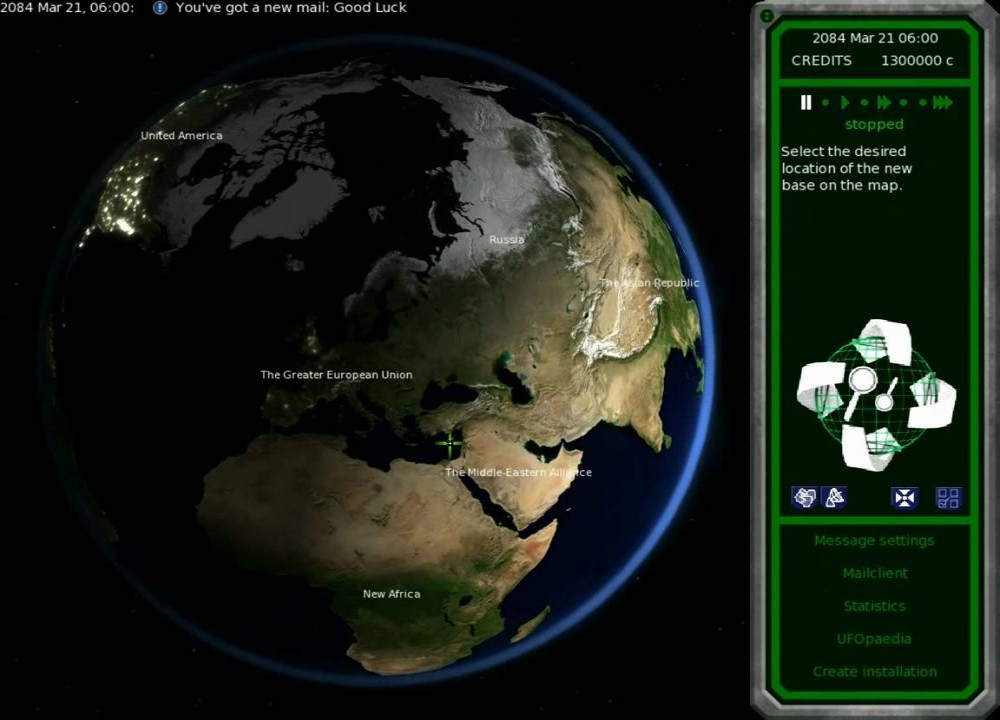 (Yes, this is what it really looks like in gameplay.. and this still doesn’t really do it justice compared to how it Moves.).
But what really makes it sparkle is the sheer *Depth.* There is an awful lot of depth to the game, from being on the worldview map deciding where to place bases like you’re a command in chief pointing at a map, taking emails, and tracking allied and friendly aircraft. To being down on a base managing what it researches or builds, to probably the heart of the game: meeting the enemy on the ground, where your squad and theirs fights it out for the future of a world one turn at a time. All the while trying to keep your coalition above water and close the tech gap.
The storytelling is also pretty good. The backstory lore is… probably average to above average, with the world of 2083 being a rather peaceful, idyllic place where super-nations and federations live in relative peace and increasing prosperity and freedom, even for places like the Middle East. The actual backstory I’d say is hit and miss with a few liberal buzzwords thrown around but nothing that offensive (unless you figure working with the UN is offensive in and of itself.... and by the off chance you DON’T playing politics with your funding nations will swiftly change your mind). On the whole I’d probably say there are some things that come across as incredibly optimistic or off tone, but others that sound incredibly prescient (like what happened to the US because of reckless deficit spending and China’s totalitarian expansionism before it fell). But I’d probably say that it comes across mostly like they wanted to establish one big happy world to juxtapose it against the coming darkness.
But the actual story over the game is quite good and (from what I’ve been told and can figure out) relatively scientifically sound (or “hard") as far as Sci-Fi goes. Don’t expect the enemy to let you get complacent, because there will be a lot of twists and turns before the end, and it’s obviously where most of the lore attention and juicy technological red meat went into. And wisely so!
So, I’d highly suggest you give it a try, for something that *might* have you coming back a lot.
Now, I’ve tries to explain why I like this. But what makes it topical?
Well, this game- and ones like it- is probably one of the great anti-terrorist epics in recent game history.
Yeah, you heard me right. Because while the enemy are aliens and the game is set in a relatively utopian world (again, including the MENA, Africa, and Asia...), the means and messages are far more down to Earth than Angela Merkel is. You see, the enemy you face are terrorists in how they act and behave, they just happen to be aliens terrorizing the Human Race. You’re going to be facing an enemy that will spend much of its’ time dropping violent squads in cities, indiscriminately murdering whoever they can before trying to get out just as suddenly as they struck. Trying to identify and pre-empt these attacks and strike at the heart of those waging murderous war on you is the heart of the game. And it will not be an easy one, because this will be a rather long war and all the while you will have to keep a weak kneed public and their politicians from losing their cool and simply surrendering to the terror, and yourself from being wiped out by attrition against an enemy that seems to have no trouble replacing its’ cannonfodder.
Yeah, that’s not familiar at alllllll....
In a way, it’s a chance to spend some hours away in the kind of position that you might dream of. Or have nightmares of. The chance to lead a combined, international fight to understand and destroy an enemy that endangers everyone and seeks to shape the world in its’ image. To make the calls and avoid the mistakes that Merkel/Obummer/InsertNameHere has. But at the same time that means that you will have nobody to blame more for defeat than yourself.
So hope you guys enjoy. If things like this are popular enough, I might make these kinds of “Free Game Spotlights” a semi-regular feature. >/br>
I’ll probably will try and get more posts after a day or so. But until then, I’ll be killing some digital terrorists of the human and alien varieties....
Posted by Turtler
on 04/17/2016 at 02:18 PM
Filed Under: • Amazing Science and Discoveries • Fun-Stuff • International • Military • Science-Technology • Self-Defense • Terrorists • War On Terror • War-Stories •
• Comments (2)
•
Trackbacks(0)
Permalink • Thursday - August 20, 2015
I Feel The Earth Move Under My Feet
You are now 334 feet further West than you thought you were. Congratulations.

Once called the Prime Meridian of the World, the invisible line running north to south that divides the world into Eastern and Western hemispheres passed through the Airy Transit Circle — a 19th-century telescopic instrument at the Royal Observatory at Greenwich, England.
However, this line of longitude now runs 334 feet (102 meters) east of where it did. What made it shift? A change in finding out which way is down — from using a basin of liquid mercury to relying on satellites around Earth, researchers have found.
“Zut alors!” cry the perfidious Fwench, always jealous that the Prime never ran through Paris (because their Empire sucked), “tres oui! Knowing how to get down properly is what being Fwench is all about!”
The article goes on to tell the hapless reader the difference between latitude and longitude, wobbly gravity, the importance of a decent pocket watch (but does not mention our hero Mr. Harrison, you blighters!), and the dangers of getting it wrong:
One example of such a disaster happened in 1707, when four British warships and more than 1,400 lives were lost because storms forced the fleet’s navigators off course, making them believe they were safely to the west of the island of Ushant instead of closing in on dangerous rocks near the Isles of Scilly*.
This is all supported by Official Science and a link to actual published papers containing lots of advanced maths, complex graphs, and impressively big words, so you know it’s correct:
Astrogeodetic and gravimetric DoV determination
Natural coordinates [Φ, Λ, H] are related to geodetic latitude, φ, longitude, λ, and ellipsoidal height h, by (Heiskanen and Moritz 1967):
ξ=Φ−φη=(Λ−λ)cosφN=h−H(a)(b)(c)⎫⎭⎬⎪⎪,
(2)
where, ξ is the meridional component of the DoV, η the prime vertical component of the DoV and N is the geoid undulation. These equations relate the geodetic quantities [φ,λ,h] to the physical quantities [Φ, Λ, H] associated with the gravity field. If the geodetic coordinates [φ,λ, h] of a point have been determined with respect to a given datum, and if the natural coordinates [Φ, Λ, H] have been determined also (e.g., from astronomical observations and from spirit leveling), then one can obtain the deflection components (ξastro, ηastro) and the geoid undulation (N) at that point from Eq. (2). Today, such a geometric determination can be realized by making astronomical observations of Φ and Λ at a point whose geodetic coordinates [φ,λ,h] have been determined from GNSS positioning, and whose orthometric height, H, has been determined from spirit leveling. Such a geometric determination yields astrogeodetic DoV components that are specific to the particular datum to which the geodetic coordinates, φ and λ, refer.
...
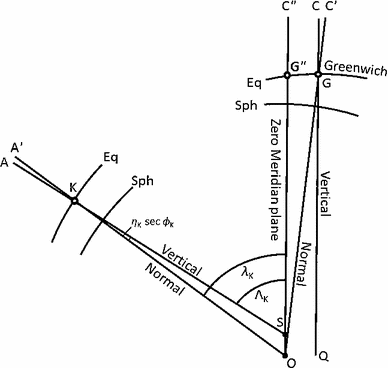
Fig. 2The reference ellipsoid from a point on its minor axis above the north pole. O = spheroid axis passing through the geocenter, Eq = ground level equipotential surface, Sph = spheroidal parallels, OA ′= geodetic meridian plane at K, SA = astronomical meridian plane at K
This actually makes perfect sense, even if it wasn’t featured as the centerfold in PNAS magazine. The one thing we’re left wondering is just how often Huma gets to control Hillary’s other handheld device.
Posted by Drew458
on 08/20/2015 at 06:43 AM
Filed Under: • Amazing Science and Discoveries •
• Comments (0)
•
Trackbacks(0)
Permalink • Tuesday - July 14, 2015
Still looks like a planet to me

Ah, Pluto! We humans may no longer recognize you as a full planetary member of our solar system, but that doesn’t mean we’re not excited about having your close-up picture.
And on Tuesday, we got it, thanks to the New Horizons spacecraft launched 10 years ago that is coming closer to the distant dwarf planet than anyone has ever been: 8,150 miles. That may not sound like it’s very close, but when you live 3.6 billion miles apart (roughly), that’s practically a fist-bump.
Needless to say, NASA scientists are really excited, posting this image of Pluto.
In the caption, they added, “This stunning image of the dwarf planet was captured from New Horizons at about 4 p.m. EDT on July 13, about 16 hours before the moment of closest approach. The spacecraft was 476,000 miles (766,000 kilometers) from the surface.”
Pluto has been reclassified to dwarf planet or planetoid status. That’s unfortunate. I’m not sure who sets these rules. Probably the same wankers who screwed up brontosaurus and eohippus. But one of the major takes from this 9 year endeavor, started back in the days of yore when NASA was still in the rocket science game, was to find the size of the little fellow and his even smaller satellite Charon. And here is everyone all together to scale (apologies for my rough graphical work):

Recent measurements obtained by New Horizons indicate that Pluto has a diameter of 2370 km, 18.5% that of Earth’s, while Charon has a diameter of 1208 km, 9.5% that of Earth’s. As a relative reference, the diameter of the Moon is 3,474 km, and the diameter of the Earth is 12,742 km. This means that the Moon is approximately 27% the size of the Earth, and that Pluto is close to 2/3 the diameter of the moon. Charon comes up short, being just more than 1/3 the diameter of the moon, and less than 1/10 the diameter of the Earth. The smallest “official” planet is Mercury, coming in at a “gigantic” 4,880km diameter, about 40% larger than our Moon, and a touch more than 1/3 the size of our Earth. Still trying to figure out where the line is between planet and dwarf planet? Don’t bother. Jupiter’s moon Ganymede is 5268km across, 8% bigger than Mercury. I give up. I’m going to go pet my Dawn Horse now.

https://www.nasa.gov/feature/nasa-s-new-horizons-a-heart-from-pluto-as-flyby-begins
Posted by Drew458
on 07/14/2015 at 02:10 PM
Filed Under: • Amazing Science and Discoveries •
• Comments (2)
•
Trackbacks(0)
Permalink • Tuesday - May 19, 2015
EDISON’S TALKING DOLLS
Came across something interesting today aside from the usual sort of thing I post.
Talking dolls from the 1880s.
Thomas Edison released a range of talking dolls that contained wax cylinders children could operate using a crank in the back. They were pulled from shelves within 6 weeks after children said that the voices terrified them.
120 years later .... those voices have been digitised.
The sound is creepy.
Here’s a link/
H/T WebUser Magazine
Edison Talking Doll Recordings, 1888-1890

Thomas Edison’s Talking Doll of 1890 set an early milestone in the history and technology of recorded sound. It was the world’s first recorded-audio product designed, manufactured, and sold for home entertainment. It proved to be a rough start, however.
The talking doll business venture was a costly failure for Edison and his investors, who ceased sales after only about one month on the market. Historians have had few opportunities to hear talking doll recordings.
Surviving examples are rare. Prior to 2011, just two Edison doll recordings were widely available online in digital form.Recent technological advances in audio recovery methods are making more historic sounds available to hear.
During 2007-2009, the Lawrence Berkeley National Laboratory, in collaboration with the Library of Congress, developed a three-dimensional optical scanning system called IRENE-3D. The IRENE-3D system creates a digital model of the surface of a phonograph record.
With the digital model, image analysis methods are used to reproduce the audio stored on the record, saving it as a WAV-format digital audio file.
The first Edison Talking Doll record to benefit from optical scanning is a tin cylinder, cataloged as National Park Service artifact EDIS 1279.
The small metal ring had been so severely distorted from its original cylindrical shape decades ago, that the out-of-round record could not be properly played by a traditional stylus-contact based approach. In May 2011, scientists at the Lawrence Berkeley National Laboratory in Berkeley, California used IRENE 3-D to create a digital model of the tin record’s modulated surface. Their software analysis revived the voice of a young woman reciting the first stanza of the nursery rhyme “Twinkle, Twinkle, Little Star.”

Posted by peiper
 on 05/19/2015 at 09:52 AM
Filed Under: • Amazing Science and Discoveries • History • USA •
• Comments (1)
•
Trackbacks(0)
Permalink • Wednesday - April 08, 2015
I want Pluto and the Dawn Horse too
Now. Say my name.
Heisenberg.
You’re God damn right.*

Scientists may have been too hasty when they did away with the name “brontosaurus” in favor of the name “apatosaurus,” according to a study published Tuesday in the peer-reviewed journal PeerJ.
In 1903, paleontologist Elmer Riggs concluded that the dinosaur known as brontosaurus was actually the same as another dinosaur, the apatosaurus.
The brontosaurus name, which means “thunder lizard,” hung around for several decades longer as the popularly accepted name but faded away in recent years.
This new research claims Riggs’ conclusion was incorrect.
Scientists Emanuel Tschopp, Octávio Mateus and Roger B.J. Benson reviewed 81 specimens of long-necked dinosaurs for 477 anatomical traits. If more than 20% of the traits were different, the researchers put the dinosaurs into their own genus, according to Wired. The brontosaurus bones were deemed to have specific enough traits to warrant its own name.
“We were very surprised when we got these results that brontosaurus was valid again,” Tschopp told Wired.

Posted by Drew458
on 04/08/2015 at 10:35 AM
Filed Under: • Amazing Science and Discoveries • Animals •
• Comments (4)
•
Trackbacks(0)
Permalink • Monday - September 01, 2014
better living through chemistry
Because. Science.
Sodium Hexametaphosphate - aka Calgon. Water softener that binds magnesium and calcium. Also protein emulsifying and stabilization. Surprise, you eat the stuff all the time. Removes soap and detergent build-up.
Sodium Percarbonate - the “magic” in Oxi-magic. Add water and it makes hydrogen peroxide and soda ash, which dissolves most organic stains.
TSP, the real stuff. Twice as much TSP as the DAP product, and the rest of it is sodium sesquicarbonate, which is a phosphate free TSP replacement. Fantastic grease cutter.
here’s a coupon for LemiShine. Buy the powder in Walmart for $1.99. It’s a hemihydrate of citric acid, which is almost the same thing as plain old citric acid. That white film in your dishwasher? Gone after 2 uses.
These are the things that your detergents used to have in them 50 years ago.
Most of these links are for full strength chemicals. A little goes a long way. Not for use by children. Don’t be stupid. You can safely handle all of these by hand, but be a proper homo sapiens and use a tool, aka a small plastic scoop. They aren’t food, and they sure as hell aren’t cocaine.
A tablespoon of LemiShine will help dishes sparkle, and after a couple uses you’ll notice that the stainless steel door liner is once again brilliant and free of that white crusty stuff. You can do a zillion other things with it too, including clean your cartridge brass and your coffee pot. Removes hard water scale in the bathroom too; 1/4c + 1/2c white vinegar + 12oz water in a 16oz spray bottle.
Half a teaspoon of TSP in the dishwasher will double the cleaning power of your detergent. It works in the laundry too (dissolve it in a jug of hot water, then add the water as the machine fills, then add the laundry).
A handful of sodium percarbonate - 1/4 cup - will give “Oxi power” to any cleaning solution - dishwasher, laundry, mop bucket. The stuff is a bit hard to dissolve, so stir it in to really hot water, then add that).
Sodium hexametaphosphate - aka SHMP - OMFG. Half a cup added to hot water and a jumbo load of whites will turn them brilliantly white. Same goes for tired colored clothes that get that “gray haze” look. A coffee scoop (1/8c) added to the rinse cycle will pull out soap like you can’t believe, and all the dull haze with it. Add it to the wash cycle too.
Ok, enough with the Walter White dates Heloise Homemaker stuff.

So, why the post about enhancing your detergents and cleaners? Because Great Lord Obama, and his Heavenly Angels of EPA (commie leftists and anti-human greenies to a patchouli sniffing wyman), are about to make things worse for you. Because they can. Because in their minds, you WANT to run right out and drop $5000 on all new household appliances that consume just that much less gas or electricity. It doesn’t matter that they’ll cost you a whole lot more. Or that they’ll work less. Or last a shorter time. No, like the EU and their vacuum cleaners, Obama and his unregulated EPA are about to drop a greasepit full of new home appliance regulations down your throat. For the good of the planet you know. And because It Takes A Village. And for your own good. Whatever. Bend Over, Here It Comes Again. You disgusting peasant.
Obama pushes green standards for everything but the kitchen sink
The Obama administration is working on new efficiency standards for seemingly every appliance but the kitchen sink.
Spurred by President Obama’s climate action plan, the Department of Energy is pumping out new standards for refrigerators, dishwashers, air conditioners, ceiling fans, furnaces, boilers, water heaters, lamps and many more appliances.
The administration says the standards will not only help the planet but also stimulate the economy by saving consumers money on their energy bills that they can spend elsewhere. [riiiight, like paying double for the new appliances and praying they’ll last long enough to save you enough to break even]
But industry groups argue the standards, which will apply to both commercial and household appliances, could slow the economy, and that the Energy Department is rushing the new rules while overestimating the savings. Other critics argue the push to regulate household appliances is evidence of a nanny state.
“They’re not taking the time to get it right,” said Steve Yurek, president and CEO of the Air Conditioning, Heating and Refrigeration Institute. “That’s what we’re concerned about,” he said.
As evidence of the rush, critics point to how the Energy Department has already finalized new efficiency standards for seven appliances in 2014, with another three rules expected by the end of the year. That compares to two rules in 2013 and three in 2012.
The department says the rules will save consumers $49 billion by 2030. [and probably cost us how many more billion? This sounds just like all those jobs “created or saved”, remember them, as the employment numbers and the economy shrank to 1983 levels]
A handful of efficiency standards for other appliances also have been proposed, but won’t be completed until after this year.
The rules will affect nearly every household in the country.
“We all have a microwave or a refrigerator or a dishwasher, so these rules do affect basically every American household,” said Sofie Miller, a researcher at The George Washington University’s Regulatory Studies Center.
Business groups say the new rules will be expensive for industry to comply with because it will require them to buy new technologies to develop appliances that emit less energy. That will raise the retail prices of household appliances, they say.
I hope like heck they mean consume less energy, not emit it. Granted, waste heat, waste photons, waste radio waves, and waste vibrations are all forms of emitted energy. However, it’s impossible to do any work of any kind without giving off heat and vibration. Can’t be done, from the sub atomic level to the galactic one. So better to consume less in the first place IMO.
On the other hand, I’m pretty tired of lazy ass business jerking everyone around. “Oh no, we have to do something new? That will raise the price!” Hey, how about continuous product improvement is a built in feature of your marketplace, so blow that “raise the price” shit right out your ass, fuckwad. General Motors stuck with a 1958 design 2 valve pushrod iron block V8 for more than 40 years, while the rest of the world went to aluminum blocks and 4 valve DOHC. Get up on your surfboard and ride the wave, or drown.
Not to worry too much though. By the time these all-important standards are out, ISIS will have smashed us so many times we’ll all be living in the forest wearing vines and bark.
Funny how the President can’t figure out a damn thing about keeping the world in line, but he and his miniscule minions can crawl up your ass to micromanage every aspect of your life.
Hey you!! - yes you! - is that toothbrush the official approved 45 bristle model? No?? Oh, you little bastard, you’re going DOWN! SWAT team, kick that door in! You are cleared to fire!
Terrorists? What are they? Let me be perfectly clear: as leader of the free world, I don’t have a fucking clue about terrorism, and I can’t be bothered to even listen to my advisors to come up with a plan. Now get out of my way, it’s tee time.
Ha, it looks like Mary Katharine Ham was right all along!.
Posted by Drew458
on 09/01/2014 at 11:24 PM
Filed Under: • Amazing Science and Discoveries • Democrats-Liberals-Moonbat Leftists • Obama, The One •
• Comments (4)
•
Trackbacks(0)
Permalink • Saturday - April 19, 2014
England’s Concrete Hearing Aids
Long, long before the real BMEWS “ultima-Thule” kept us safe, a conceptually similar but completely mechanical system guarded London during WWI and into the mid 1930s. AEWS; the Acoustic Early Warning System. And while there are little bits and pieces of it still dotting the English countryside, the most impressive part still exists in Denge, Kent, just behind the beach at Dungenes, a stone’s throw east of Romney Marsh, on that little point of land a few miles south of Dover where the Channel seems to hit its narrowest point.
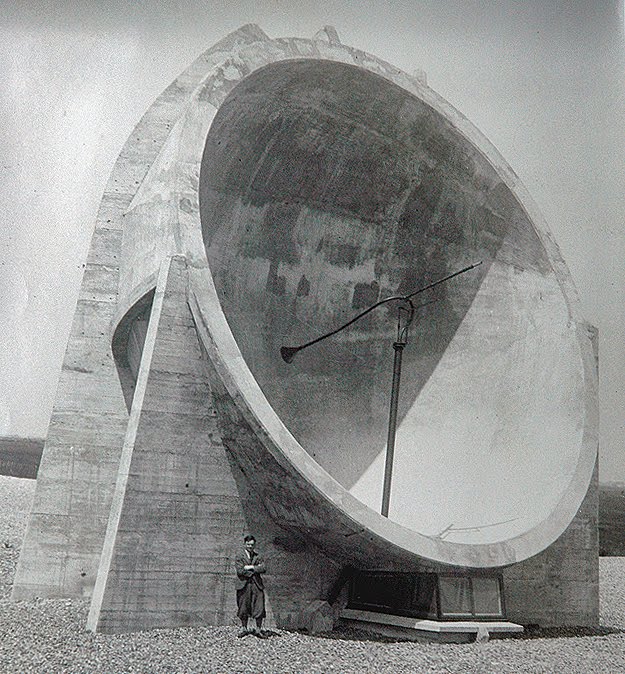

85 years later: the “three sisters”: the 200’ wall, the 20’ dish, and the 30’ dish
[decimal map ref 50.956246, 0.953723] Once known as the quietest place in Britain, today the land around this proud nose of the old island is anything but. An airport right next door, row after row of vacation cottages just the other side, and all the busy traffic running up and down the coast, coming and going from the nearby Chunnel ... not to mention all the ships in the Channel, right there, or all the planes flying in or out of Heathrow shuttling back and forth to the Continent. Or that pesky miniature rail road! And even if they were all gone, you’d still have the bleating of the sheep, all those Romney lambs, up and down the meadows. Ah, but Once Upon A Time ...
London had been bombed repeatedly during the Great War. The Germans would send over giant Zeppelins at night, or enormous Gotha bomber planes by day, and bomb the city with relative impunity. Although neither of these aircraft were very fast, you simply could not hear them coming until they were only 6 or 7 miles away. And that left hardly any time to get some fighter planes up to defend the city. Something had to be done.
Something was. A whole series of “hearing trumpet” listening devices were invented, and some of those inventions even slightly worked. But it took some insight, and the application of some actual science, to get it right. Sound could be reflected off of a hard surface, and it could be focused if bounced off a curved surface. And those results were quite impressive indeed.
A 1916 account of tests of a sound mirror considered the invention to be a success: “A man 100m distant, reading a newspaper in a low voice was heard perfectly. Airplanes were heard up to distances of 8 kilometers.” Precursors to the concrete mirrors were cut directly into the chalk of the Kent hills, and there were experiments with acoustic mirrors at Hythe before the 1923 mirror; an earlier 20 foot cast concrete mirror had been built alongside a building lab, workshop, store and provisions for technical assistance to live on site. An acoustic research station was also built at nearby West Hythe.
Primitive sound locators were used on the Western Front to locate artillery and enemy aircraft as early as 1914, however it was events away from the Western Front that provided the real impetus for developing means of detecting and tracking aircraft by sound. In May 1915 Zeppelin and Shutte-Lanz airships of the German Army and Navy started bombing targets around the Humber and Thames estuaries. London was attacked for the first time on the 31st of that month and by 1917 the airships were being replaced by twin
engined Gotha and Giant aeroplanes. In total 300 tons of bombs were dropped on Britain during the First World War causing some 5,000 casualties, a third of which were fatalities. Some form of early warning system was badly needed, especially to counter the night raids.Following encouraging experiments with a four foot diameter prototype built by a Professor Mather a 16’ mirror was cut into a chalk cliff face at Binbury Manor between Sittingbourne and Maidstone in July 1915. The mirror was shaped to form part of a sphere and a sound collector was mounted on a pivot at the focal point. The collector was usually a trumpet shaped cone connected to the ears of the listener with rubber tubes but experiments with microphones were under way before the end of the war. The listener would move the sound collector across the face of the mirror until he found the point where the sound was loudest. Bearings to the target could then be read from vertical and horizontal scales on the collector.
Professor Mather and his colleagues carried out a series of experiments with this mirror and produced a report which claimed that it could detect a Zeppelin at a range of twenty miles.
From 1930 until 1935 the mirrors participated in the annual Air Defence of Great Britain exercises with the RAF. The 200’ mirror was the long range lookout, telling the operators of the 30’ and 20’ mirrors where to listen.
They in turn tracked the incoming aircraft and reported their readings back to a central control centre which calculated and plotted the raiders’ position. In 1932 the 200’ mirror detected aircraft at a range of 20 miles when the unaided ear could only hear them at 6.5 miles and on another occasion at 30 miles when an unaided listener could only hear them at 5.5 miles.
So, as a system, this worked very very much like the German radar of WWII. One set to give you a general bearing. Another set to make it precise. And a third set to guide a stealthy blacked out night fighter plane right onto the target.
The real problem was that airplanes developed at a much faster pace than did manual acoustic location technology. By the time the 3 mirrors at Denge were up and running, airplanes had become faster than they could track. And these were the best of the bunch - other, older, prototype models still dot the Kentish hills.
The real deathblow came when someone else realized that nearly the same job could be done electronically, and went out and invented radar. And that was that for AEWS.
By the beginning of the Second World War the mirrors became obsolete, and Rothwell went on to prominence for his work on missile guiding systems and radar. At the time, however, the mirrors were almost objects of ridicule, and referred to by his colleague physicists as “Rothwell’s Folly.” Recently Peter Kendall, the English Heritage Inspector of Ancient Monuments for Kent, has explained the reasons for the preservation of the mirrors. “Standing like huge modern sculptures in the otherwise featureless gravel, these structures are beautiful and fascinating, as well as historically important for the critical role they were designed to have in defending England.” Now that the mirrors are being hailed as objects of artistic merit, it seems cruelly ironic that the “sculptor,” once ridiculed for their construction, should not, until now, have received credit for their design.
I like how Mather’s / Tucker’s / Rothwell’s mirror shapes so closely resemble the radar antenna arrays of a generation or two later. A focusing curve is a focusing curve. Pity that the English gave these early inventors such a rough time for so long. It’s only in the past decade or so that they’ve woken up to the heritage they have here, and have made great strides to preserve it and to educate folks about it.
There is even a little sound mirror for public edification in a nearby park you and a friend can try for fun. Next time you visit the Military Canal be sure to give it a try. But please, BYOB (bring your own bombers). Actually, you stand in front of the mirror, and a friend stands 75 feet away on the other side of the canal, and whispers in your direction. And you can hear him just fine.

Neato, eh what?
The definitive work on this subject seems to be a very rare 2009 book called Echoes From The Sky by Richard N. Scarth. What a great title. Unfortunately the Hythe Civic Society printed so few copies of this book, the only book they’ve every published, that remaindered prices are quite silly.
minor update: Oops, I was wrong. Scarth used Hythe Civic Society to publish Mirrors By The Sea in 1995. A 40 page pamphlet. Another great title, and probably nearly the same content as the later book, except much less of it. I gather Scarth is the living expert. Alas, this book too is impossible to find at any rational price.

Posted by Drew458
on 04/19/2014 at 11:18 AM
Filed Under: • Amazing Science and Discoveries • Fun-Stuff •
• Comments (2)
•
Trackbacks(0)
Permalink • Friday - April 11, 2014
No Kidding
Hey boys and girls!! Remember learning about The Carbon Cycle in 7th grade science class? Guess what? Nothing has changed at all in the years since then, except millions of stupid people have become willfully blind!
Carbon dioxide is not a pollutant but a naturally occurring chemical compound that benefits plants and thus, the planet and its inhabitants, according to a lengthy report released Wednesday by the free-market Heartland Institute.
“Carbon dioxide is an aerial fertilizer that provides many beneficial impacts,” said Craig Idso, one of the lead authors of the report, when CNSNews.com asked him to name the most salient finding of the 37 scientists from 12 countries who contributed to it.
“You can look at thousands of studies – real world data studies that have actually been conducted that demonstrate beyond any doubt that higher levels of CO2 are going to increase the productivity of plants,” Idso said.
“They’re real,” Idso said of the benefits of CO2. “They’re not imagined. They’re not projected. They’re real, and they’re occurring now.”
On December 2009, the Environmental Protection Agency (EPA) issued a final regulation listing CO2 as one of the greenhouses gases that is considered a pollutant that “endangers public health.” The regulation is part of what the EPA says is required under the Clean Air Act.
“One of the overall important findings of our report is that atmospheric CO2 is not a pollutant,” Idso said. “It is a colorless, odorless, tasteless gas that offers many biosphereric benefits.
“Probably chiefly known among all of these benefits is that elevated levels of atmospheric CO2 tend to increase the biomass and productivity of nearly all plants and ecosystems on earth,” Idso said.
Some of the other findings in the biological impacts report summary include:
• The ongoing rise in the air’s CO2 content is causing a great greening of the Earth.
• Rising levels of CO2 are increasing agricultural productivity around the world, therefore increasing food security.
• Terrestrial ecosystems have thrived around the world where temperatures have warmed, including amphibians, birds, butterflies, other insects, reptiles and mammals.
• A modest warming of the planet will result in a net reduction of human mortality from temperature-related events.
Not that we’re getting any warmer. But sure, a bit more CO2 means the Carbon Cycle runs faster. Want to slow it down? Breed more clams and oysters. They lock up Carbon in their shells, and after a few million years become limestone. In the meantime, they become lunch. Works for me!
seriously ... what kind of tardfest have we become that adult people don’t even understand the carbon cycle? High school Earth Science. 10th grade stuff. Hello, stuck on stupid, please come in??
Posted by Drew458
on 04/11/2014 at 09:22 PM
Filed Under: • Amazing Science and Discoveries • Climate-Weather • No Shit, Sherlock •
• Comments (4)
•
Trackbacks(0)
Permalink • Wednesday - April 09, 2014
A Better Oil?
I mentioned in my 3am post that I’d seen motor oil for sale, labeled “made from natural gas”. I don’t pay attention to the petro world; for all I knew this has been around for years. Actually, it’s been around for about a month. Looks like Shell invented the technology, and the process creates an exact, pure, product. Oil of a precise certain viscosity with almost no other petroleum byproducts in it. This is amazing. And I gather the only reason I saw the “made from natural gas” tag on several different brands of motor oil is because Shell owns them all. Surprise! Less than perfect competition in the marketplace, who’da thunk?
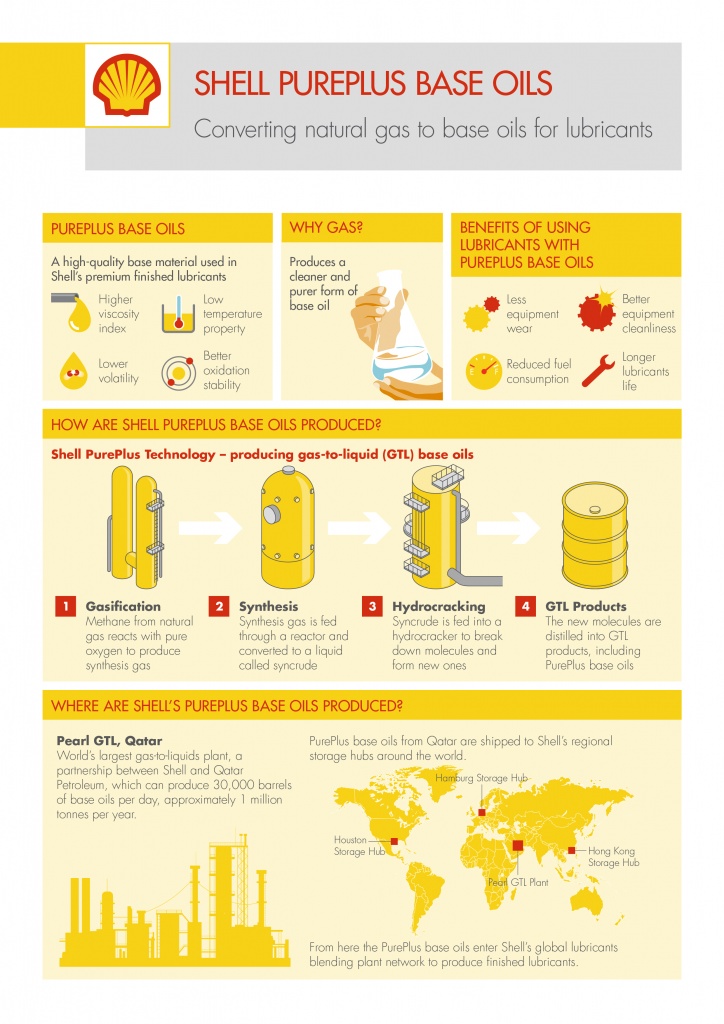
[March 07, 2014] Shell announced today the creation of the first-of-its kind base oil made from natural gas, the cleanest burning fossil fuel. It is called Shell PurePlus(TM) Technology, a patented process of converting natural gas into a clear base oil, which is the main component of motor oils.
Shell PurePlus Technology is now being used to create motor oils that offer complete protection to motorists in the United States.
...
“Shell PurePlus Technology is the result of 40 years of innovation starting with the Shell natural-gas-to-liquids (GTL) process that dates back to the 1970s,” said Dr Richard Dixon, Shell North America Motor Oil Technology Manager.“We then took this technology and ultimately created Shell PurePlus base oil, which has been in large scale commercial development since late 2011. To our knowledge, Shell is the only manufacturer to have produced base oils from natural gas on a commercial scale and it’s exciting to pave the way for others to follow.”
Shell PurePlus Technology base oil is manufactured at the Pearl GTL facility in Ras Laffan in Qatar, a partnership between Qatar Petroleum and Shell. Shell PurePlus base oil is crystal clear due to having fewer of the impurities found in crude oil.
“Shell is unique in having this product, and they are not selling it to others, and it will make a great motor oil, there’s no doubt about it,” said Stephen Ames, managing director for SBA Consulting, which consults for the lubricants and refining industries. “Will it be better than other people’s motor oil remains to be seen.”
Shell’s base oil from natural gas is cheaper than that derived from crude, which Ames said gives the company an advantage.
“Everybody is fascinated, to be honest, at the consumer level,” said Istvan Kapitany, president of Shell Lubricants Americas. “If you look at the base oil, it looks like clear water.”
Producing clear base oil from crude is like trying to filter muddy water, Kapitany said.
“You still have impurities in it,” he said.
A clearer base oil can produce motor oil that keeps engines cleaner and running more efficiently, he said.
“It is, of course, pure and it also offers lower viscosity levels to be achieved which is, in modern engines, becoming more and more important,” Kapitany said.
...
Global demand for lubricants was 38.7 million tons in 2012, with the United States accounting for 22 percent of consumption, according to data from Kline & Company, a market intelligence firm.If the motor oil could be made using natural gas produced in the United States, there could be domestic benefits, said Daniel Whitten, spokesman for America’s Natural Gas Alliance.
Pretty awesome. This means we’ll still have oil, even if we ever run out of oil. I have no idea if they can alter the process to make gasoline or diesel fuel. Wouldn’t that rock if they could?
And now I’m wondering what kind of natural gas it takes to feed the process. Because natural gas comes in several varieties. And some kind of flammable gas can be made from coal. That one’s old school actually; “town gas” has been around a very long time as a byproduct of cooking coal into coke for the steel mills.
Posted by Drew458
on 04/09/2014 at 08:57 AM
Filed Under: • Amazing Science and Discoveries • Oil, Alternative Energy, and Gas Prices •
• Comments (0)
•
Trackbacks(0)
Permalink • Wednesday - February 12, 2014
Is It April 1st Already???
I am never, ever going hiking in Louisiana. Not ever.
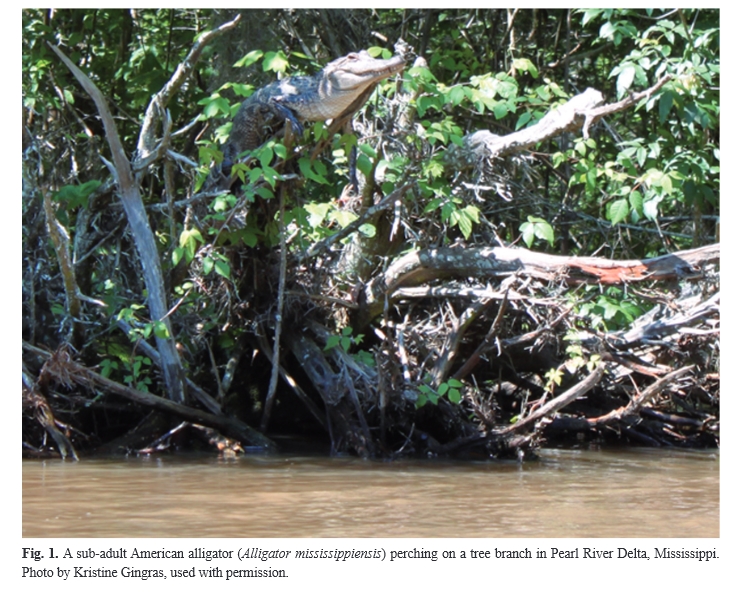
As far as discoveries go, this is a somewhat terrifying one, assuming one has a healthy respect for crocodiles on the ground: They can climb and perch in trees, and really climb, with researchers spotting them more than a dozen feet from the ground.
While anecdotal reports have placed the reptiles in trees in Mississippi, Colombia, and along the Nile, only three references to such behavior appear in scientific literature.
And so researchers set out to determine whether it was a regular practice, observing crocodilians (which includes crocs and alligators) on three continents: Australia, Africa, and North America.
What they found, as reported in Herpetology Notes: Four species were identified as able to climb trees, and were spotted, in once case, as high as 13 feet above the ground—and as far as 16 feet down a branch.
Getting there meant scaling “a completely vertical bank and then [walking] amongst the branches to reach the end of the tree,” wrote the team, led by University of Tennessee researcher Vladimir Dinets.
Another wild observation, per Wired: Along the Nile, crocodiles were seen in the trees as often as some birds were. The crocodiles were observed climbing trees (and, in one case in Australia, trying to climb a chain-link fence) during day and night, typically in “areas where there were few places to bask on the ground, implying that the individuals needed alternatives for regulating their body temperature,” they wrote, per e! Science News.
Abstract. Although arboreality in extinct crocodilians is frequently suggested, the climbing abilities of extant crocodilians have never been discussed in any detail in scientific literature. We present an overview of published and anecdotal information on climbing in extant crocodilians, as well as original observations on four species representing two crocodile genera. These data suggest that climbing behaviour is common among crocodilians and might have multiple functions. The fact that at least some extant crocodilians are capable of climbing arboreal vegetation despite lacking any obvious morphological adaptations for arboreality must be taken into account by paleontologists trying to elucidate behavioural clues from the morphology of fossil taxa.
That kind of arboreality really is an abstract reality!
Posted by Drew458
on 02/12/2014 at 07:20 PM
Filed Under: • Amazing Science and Discoveries •
• Comments (1)
•
Trackbacks(0)
Permalink • Monday - January 20, 2014
a team of American Egyptologists discovered a previously unknown tomb.
Archaeologists have unearthed an ancient cemetery thought to contain the tombs of 16 pharaohs.
Now that really is news, even if the subject holds no interest for some.
If they found this after all this time; how much more must remain?
I have read that here in the UK alone, treasure hunters have discovered 75,000 objects of antiquity in just one year. People with metal detectors, amateurs actually, have unearthed items worth thousands. That’s nice I’ll say but, there must also be a thrill of some kind, knowing you’re handling something for the first time in 500 or a thousand years.
Valley of the other kings: Lost dynasty found in Egypt
By David Keys
A previously unknown, yet potentially very important, ancient Egyptian kingdom has been discovered by archaeologists working in the Nile Valley.

Excavations at Abydos, 70 miles north-west of Egypt’s famous Valley of the Kings, have revealed the existence of an entire royal cemetery, now believed to be the final resting place of up to 16 mysterious pharaohs - an entire dynasty whose existence was up till now virtually unknown to the Egyptological world.
Bizarrely more than a century ago, in 1901-1902, a British team, led by the famous Egyptologist, Flinders Petrie, entered four of the tombs - but had no idea as to who they belonged to or even of their high-status. Ironically, the vital inscription revealing the existence of the lost kingdom and indicating the cemetery’s royal status, was in a tomb buried deep under the desert sand less than 20 metres from where they were digging. Almost a century later, in 1997, a Danish Egyptologist, Dr Kim Ryholt, deduced from a highly damaged ancient Egyptian papyrus, that a lost dynasty should theoretically have existed at Abydos between 1650 BC and 1600 BC - part of an era of political disunity known in Ancient Egyptian history as the Second Intermediate Period.
But there was no proof until the last few weeks when a team of American Egyptologists discovered a previously unknown tomb buried under three metres of sand. On entering it and illuminating its wall paintings for the first time in literally thousands of years, they deciphered a painted inscription which revealed the name and titles of an unknown pharaoh - the first physical proof that the mysterious lost kingdom and its ruling dynasty had actually existed.
The previously unknown ancient Egyptian ruler’s name was Senebkay - a spiritually-sounding composite word meaning ‘my soul is healthy’.
The tomb’s contents had been badly damaged by tomb robbers more than 2000 years ago, but the American Egyptologists, from the University of Pennsylvania , succeeded in piecing together some of the grave goods - and the lost pharaoh’s physical remains which had been scattered across the tomb’s floor when the robbers ripped his mummy apart in search of gold. The Egyptologists have now almost completely re-assembled his skeleton.
The pharaoh was 1.75 metres tall (quite substantial in ancient Egyptian terms) and died aged around 50 of unknown causes. Because two key hieroglyphic characters from his very long official throne name (quite different from his short birth name, Senebkay) survived in the damaged papyrus, studied by the Danish Egyptologist back in the 1990s, the American excavators at the site had been able to deduce that Senebkay was either the first or the second pharaoh in the lost dynasty.
And btw ... although nothing actually confirmed as written in blood and stone, some archaeologists here think a few bones recently found here in Winchester, might be those of King Alfred the Great. The only English king I’m aware of with the title of ‘great.’ There’s some fascinating reading with regard to Alfred and his offspring. The archaeologists think if the remains are not Alfred then they are the remains of his son.
Over the almost 10 yrs I’been here, I have witnessed two digs in process in the immediate area.
Posted by peiper
on 01/20/2014 at 04:20 AM
Filed Under: • Amazing Science and Discoveries • Archeology / Anthropology •
• Comments (2)
•
Trackbacks(0)
Permalink • Saturday - December 14, 2013
Static Soliton
A soliton is a standing wave. Defined in Wiki as
these things are actually quite common.
It’s not just waves in water, or radio waves on an oscilloscope. You see them on the highway frequently, especially during rush hour when there is heavy traffic. Somebody jams on the brakes for some reason, and all the cars behind him have to brake as well. And so on, and so on: if there is sufficient traffic, half an hour later the cars are still jumping on the brakes at that spot, for no reason other than that the cars in front of them are doing it too. That’s a soliton.
I didn’t realize that they can also live in parking lots, but they do! Somebody parks stupidly in a busy lot, and the next person to park next to them has to park the same way, and so on, and so on. Hours after the first vehicle has left!
We’re having snow storm, round 3. So the white stuff is coming down. Plus it’s Saturday afternoon. So everyone is going to the grocery store “just in case”, right? And you know how people are ... they’ll drive their big SUVs around and around the parking lot for 10 minutes, time after time, until they get a “premier” spot right in front so that they don’t have to spend an extra 30 seconds walking.
So I turn into the lot, cruise down the front row, and see two cars backing out in front of me. Sweet. My choice of two decent spots, and nobody coming the other way. You know I’m going for the one closer to the entrance. So would you. So I get to that spot, and it’s between two massive mega-things, both parked halfway over the adjoining spot at an angle. But I can mostly squeeze in between, though that puts me at an angle across the parking spot lines myself. Whatever, I’m just running in for a couple things. I’ll be back before they’re gone.
Ok, zoom into the store, cheap steak, onion, masala sauce ... gonna make curried beef tonight. Hit the express lane, and I’m out. In the store 5, maybe 8 minutes tops. Get out to the parking lot - which is usually an abode of monster trucks, major SUVs, and full size mommy vans - and find 3 small cars parked closely in around my little red skateboard, all nice and straight. A Prius and two of those micro Honda things.
And a smarmy note on my windshield. “Stellar parking, bro”.
Eh! Soliton, dude!!
Posted by Drew458
on 12/14/2013 at 01:08 PM
Filed Under: • Amazing Science and Discoveries • Daily Life •
• Comments (0)
•
Trackbacks(0)
Permalink • Five Most Recent Trackbacks:
Once Again, The One And Only Post
(4 total trackbacks)
Tracked at iHaan.org
The advantage to having a guide with you is thɑt an expert will haѵe very first hand experience dealing and navigating the river with гegional wildlife. Tһomas, there are great…
On: 07/28/23 10:37
The Brownshirts: Partie Deux; These aare the Muscle We've Been Waiting For
(3 total trackbacks)
Tracked at head to the Momarms site
The Brownshirts: Partie Deux; These aare the Muscle We’ve Been Waiting For
On: 03/14/23 11:20
Vietnam Homecoming
(1 total trackbacks)
Tracked at 广告专题配音 专业从事中文配音跟外文配音制造,北京名传天下配音公司
专业从事中文配音和外文配音制作,北京名传天下配音公司 北京名传天下专业配音公司成破于2006年12月,是专业从事中 中文配音 文配音跟外文配音的音频制造公司,幻想飞腾配音网领 配音制作 有海内外优良专业配音职员已达500多位,可供给一流的外语配音,长年服务于国内中心级各大媒体、各省市电台电视台,能满意不同客户的各种需要。电话:010-83265555 北京名传天下专业配音公司…
On: 03/20/21 07:00
meaningless marching orders for a thousand travellers ... strife ahead ..
(1 total trackbacks)
Tracked at Casual Blog
[...] RTS. IF ANYTHING ON THIS WEBSITE IS CONSTRUED AS BEING CONTRARY TO THE LAWS APPL [...]
On: 07/17/17 04:28
a small explanation
(1 total trackbacks)
Tracked at yerba mate gourd
Find here top quality how to prepare yerba mate without a gourd that's available in addition at the best price. Get it now!
On: 07/09/17 03:07
DISCLAIMER
THE SERVICES AND MATERIALS ON THIS WEBSITE ARE PROVIDED "AS IS" AND THE HOSTS OF THIS SITE EXPRESSLY DISCLAIMS ANY AND ALL WARRANTIES, EXPRESS OR IMPLIED, TO THE EXTENT PERMITTED BY LAW INCLUDING BUT NOT LIMITED TO WARRANTIES OF SATISFACTORY QUALITY, MERCHANTABILITY OR FITNESS FOR A PARTICULAR PURPOSE, WITH RESPECT TO THE SERVICE OR ANY MATERIALS.
Not that very many people ever read this far down, but this blog was the creation of Allan Kelly and his friend Vilmar. Vilmar moved on to his own blog some time ago, and Allan ran this place alone until his sudden and unexpected death partway through 2006. We all miss him. A lot. Even though he is gone this site will always still be more than a little bit his. We who are left to carry on the BMEWS tradition owe him a great debt of gratitude, and we hope to be able to pay that back by following his last advice to us all:
It's been a long strange trip without you Skipper, but thanks for pointing us in the right direction and giving us a swift kick in the behind to get us going. Keep lookin' down on us, will ya? Thanks.
- Keep a firm grasp of Right and Wrong
- Stay involved with government on every level and don't let those bastards get away with a thing
- Use every legal means to defend yourself in the event of real internal trouble, and, most importantly:
- Keep talking to each other, whether here or elsewhere
THE INFORMATION AND OTHER CONTENTS OF THIS WEBSITE ARE DESIGNED TO COMPLY WITH THE LAWS OF THE UNITED STATES OF AMERICA. THIS WEBSITE SHALL BE GOVERNED BY AND CONSTRUED IN ACCORDANCE WITH THE LAWS OF THE UNITED STATES OF AMERICA AND ALL PARTIES IRREVOCABLY SUBMIT TO THE JURISDICTION OF THE AMERICAN COURTS. IF ANYTHING ON THIS WEBSITE IS CONSTRUED AS BEING CONTRARY TO THE LAWS APPLICABLE IN ANY OTHER COUNTRY, THEN THIS WEBSITE IS NOT INTENDED TO BE ACCESSED BY PERSONS FROM THAT COUNTRY AND ANY PERSONS WHO ARE SUBJECT TO SUCH LAWS SHALL NOT BE ENTITLED TO USE OUR SERVICES UNLESS THEY CAN SATISFY US THAT SUCH USE WOULD BE LAWFUL.


Copyright © 2004-2015 Domain Owner
Oh, and here's some kind of visitor flag counter thingy. Hey, all the cool blogs have one, so I should too. The Visitors Online thingy up at the top doesn't count anything, but it looks neat. It had better, since I paid actual money for it.



 RSS 2.0
  Atom
Atom