
 Saturday - March 28, 2015
Purple Finger Time
[ Rats. I was hoping I could title this one “To the Bhat polls, Rabin”. Alas, Bhat is a boiled rice dish eaten in India, not Nigeria*. All I can say here is “Goodluck, Jonathan” ]
Nigerians brave Boko Haram to cast ballots
In northern Nigeria and bordering countries, a regional offensive is underway against the ruthless Islamist terrorist group, Boko Haram. The campaign comes in the midst of a postponed election and a tightly contested presidential race.
After a six week delay, Nigerians will head to the polls Saturday to vote in presidential and national assembly elections. The security environment in northern Nigeria has improved over the last six weeks, yet Boko Haram still has both means and motive to disrupt and discredit the electoral process. This danger is particularly strong in Northeastern Nigeria where the militant group is trying to establish an ‘Islamic Caliphate’ under Sharia law.
Conducting elections amid a violent insurgency is challenging enough, but Nigeria’s situation is further complicated by the possibility of post-electoral violence. In the wake of Nigeria’s last presidential and national assembly elections in 2011, rioting by those dissatisfied by the results left more than 800 people dead. And tensions are high once again.
This year’s presidential contest is extremely close. While both the incumbent, President Goodluck Jonathan, and the main opposition leader, General Muhhamadu Buhari, have signed a peace agreement, observers remain concerned about how their political supporters will react once the election results are known.
On Monday, a political rally of General Buhari’s supporters escalated to violence. Participants slashed President Jonathan’s posters and hurled rocks at his campaign office in Kaduna, a city in the North that was an epicenter of violence in the previous election between President Jonathan and General Buhari. The stakes are even higher this cycle.
So, if Obama’s efforts to bring back psycho dictator Buhari fail, riots will ensue? Sounds like that side has “escalated” to violence ahead of time. Bit of a threat perhaps?
For Nigeria, this is a watershed moment—for national security, for the economy and for democratic governance. The West African country is an anchor in the region. It boasts the region’s largest population (about 170 million people), serves as a cultural driver, and pushes Africa’s economic progress. Yet Nigeria is plagued with severe corruption, violent Islamist terrorists and severe economic disparity.
And if Goodluck Jonathan wins, how will Obama punish them, like he tried to do when he blew it in Israel?

Posted by Drew458
 on 03/28/2015 at 01:41 PM
Filed Under: • Africa •
• Comments (0)
 •
Trackbacks(0)
Permalink •
•
Trackbacks(0)
Permalink • Friday - March 27, 2015
Throwing Nigeria Under The Bus
Must Read links to three posts that show how US foreign policy has shifted to destroy Nigeria and Christian President Goodluck Jonathan, while David Axelrod’s goons push militant islamist communist candidate General. Muhammadu Buhari.
Six years ago if you had heard of a United States president behaving this way, you might have been shocked. But today, we are no longer surprised by Obama’s lethal perfidy. We watch helplessly and with horror as the world crumbles.
At least 13,000 civilians dead in Nigeria since 2009 and the US looks the other way because Obama wants to put a progressive Muslim in power.
A political consulting firm founded by Obama administration confidante David Axelrod has been far more involved in backing controversial Nigerian presidential candidate Gen. Muhammadu Buhari than previously disclosed, according to a series of emails obtained by the Washington Free Beacon and interviews with sources on the ground.
Axelrod’s firm, the Chicago-based AKPD, has admitted to doing work on behalf of Buhari’s All Progressives Congress (APC) party in the past, but claimed to have ceased its ties in March 2014 after the Islamist terror group Boko Haram kidnapped hundreds of Nigerian schoolgirls.
However, emails sent between senior APC party members and advisers show that contrary to the firm’s claims, AKPD has quietly continued to perform political work on Buhari’s behalf as he fights to unseat current President Goodluck Jonathan.
Sources on the ground in Nigeria and familiar with how the elections have been shaping up say Buhari has run an uncharacteristically disciplined campaign.
“They have run … a well disciplined message campaign, running on a clear and singular message of change,” said one source who agreed to discuss the matter only on background. “It sounds very familiar to another campaign some Americans might remember from seven years ago.”
While the APC has had trouble displaying unity in past election bids, the current campaign has showed few signs of dissent, the source explained.
“It strongly points to coaching they ordinarily would not have had in past elections,” according to the source. “That’s really the clearest sign that I’ve seen and other have seen that these guys are running a Western-style, Western-directed campaign that has identified a message through polling and research.”
While Buhari has positioned himself as an agent of change, critics point to his controversial and oppressive rule over Nigeria in the 1980s.
Buhari’s military government was known for harshly cracking down on civil rights, arresting opposition forces, and intimidating critical journalists. Human rights activists routinely criticized Buhari’s military rule. Buhari was deposed in a 1985 coup.
When the notorious Islamic terrorist group, Boko Haram, kidnapped 278 school girls from the town of Chibok in northeastern Nigeria last year, Michelle Obama began a Twitter hashtag campaign, #BringBackOurGirls. But behind the scenes, the Obama administration was undermining Nigeria’s efforts to take the battle to the terrorists. Obama refused to sell Nigeria arms and supplies critical to the fight, and stepped in to block other Western allies from doing so. The administration also denied Nigeria intelligence on Boko Haram from drones operating in the area. While Boko Haram was kidnapping school girls, the U.S. cut petroleum purchases from Nigeria to zero, plunging the nation’s economy into turmoil and raising concerns about its ability to fund its battle against the terrorists. Nigeria responded by cancelling a military training agreement between the two countries.
The Nigerian presidential election is coming up Saturday, March 28, 2015. AKPD, the political consulting group founded by Obama confidante David Axelrod, is assisting Retired Gen. Muhammadu Buhari, a Muslim presidential candidate from Muslim-dominated northern Nigeria, where Boko Haram was spawned and wields the most influence. Buhari is well-known throughout the country, having led as “Head-of-State” following a military coup in 1983. He was dislodged following another coup in 1985.
Nigerian officials seeking to purchase weapons, especially Cobra attack helicopters, were outraged at Obama’s refusal to allow these transactions. Nigeria’s ambassador to the U.S., Professor Adebowale Adefuye, stated publicly that:
The U.S. government has up till today refused to grant Nigeria’s request to purchase lethal equipment that would have brought down the terrorists within a short time on the basis of the allegations that Nigeria’s defence forces have been violating human rights of Boko Haram suspects when captured or arrested.
We find it difficult to understand how and why, in spite of the U.S. presence in Nigeria, with their sophisticated military technology, Boko Haram should be expanding and becoming more deadly.
Another official quoted in the Nigerian newspaper ThisDay, stated:
The U.S. government has frustrated Nigeria all the way in our war against terrorism despite its public statements in support of Nigeria, as it fights the Boko Haram insurgents in the North-east… They want us to fight Boko Haram with our arms tied to our backs.
They have blocked us from procuring the helicopters and would not provide us with intelligence despite the fact that they have several drones and sophisticated aircraft overflying the North-east of Nigeria from bases in Niger and Chad where the Boko Haram fighters and movements are clearly in their sights.
Retired Col. Abubakar Umar, a former military governor, concluded that the Americans “have decided to turn a blind eye to what is happening in Nigeria.”
According to Nigeria’s President Goodluck Jonathan, more than 13,000 people have been killed in the Boko Haram insurgency since 2009. Some estimates put the carnage as high as 17,000 deaths.
Between July 2013 and June 2014 alone, an estimated 7,000 people died in incidents related to the insurgency. Boko Haram – which means “Western education is forbidden” – recently pledged allegiance to ISIS.
When these formidable jihadists rampaged through Nigeria, last year – kidnapping schoolgirls, slaughtering Christians, and burning down churches, the Obama administration’s primary response was a hash-tag campaign on Twitter. If the besieged people of Nigeria expected more than lip service from the United States in their battle against Boko Haram in the days and weeks that came, they were sorely mistaken. They got bupkis.
Clearly, a more serious response than #BringBackOurGirls was needed to combat the growing menace – but the United States all but abandoned their African ally. Not only did the Obama Regime refused to sell Nigeria the arms it needed to fight Boko Haram, it blocked other Western allies from helping them, too.
Oh, and don’t forget the crazy Tuareg almost right next door in Mali, killing, rampaging, and taking slaves left and right as they set up their own African Caliphate ... and they’re now armed to the teeth with tons of weapons stolen from the fall of Libya. A fall enabled for no visible reason by pResident Obama and Secretary of State Clinton, deposing a quiescent dictator and plunging that nation into complete and unending fratricidal chaos. And this was before Boko Haram, and before Mali. Almost seems like they found the right domino and just gave it a kick. And then they just walked away.
The Tuareg have won in Mali. A treaty is being signed that gives them their caliphate, a Texas sized chunk of land they’re calling Asswad Azawad.
Ethnic divisions run deep in the northern desert, the cradle of a Tuareg separatist movement which has spawned several rebellions since the 1960s.
The 30-page peace agreement calls for “reconstruction of the country’s national unity” in a way that “respects its territorial integrity and takes account of its ethnic and cultural diversity”.
In deference to the concerns of the government about separatism, it does not use the word autonomy in setting out the powers the region will enjoy.
It proposes the creation of powerful elected regional assemblies led by a directly elected president, as well as “greater representation of the northern populations in national institutions”.
From 2018, the government will set up a “mechanism to transfer 30 percent of budget revenues from the state to local authorities… with particular attention to the North”.
This may seem rather innocuous, but the northern half of Mali is pretty much empty. Nobody lives there. No cities, no towns, no roads, no lakes, no farms. Just wildmen. Tuaregs. So 30% of the national revenue, even in poverty stricken Mali, is some major Danegeld. Tribute. Protection money.
Posted by Drew458
on 03/27/2015 at 07:40 AM
Filed Under: • Africa • Obama, The One •
• Comments (3)
•
Trackbacks(0)
Permalink • Saturday - November 15, 2014
out of afrika, and lets not forget the bees.

H/T Lynne P.

Posted by peiper
 on 11/15/2014 at 06:01 AM
Filed Under: • Africa •
• Comments (2)
•
Trackbacks(0)
Permalink • Tuesday - July 22, 2014
Fallen Off The Radar Screen
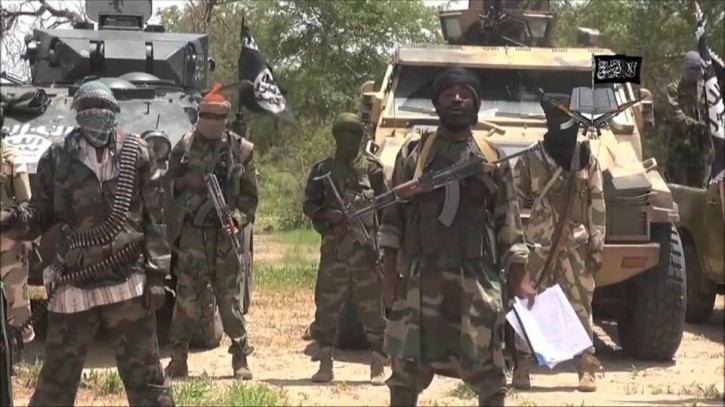
Nigeria marked a solemn milestone Tuesday in the abduction of more than 200 schoolgirls. Exactly 100 days after the girls were kidnapped by by Islamic extremists Boko Haram, 219 of them were still missing, a presidential committee said. In the three months since they were taken, at least 11 of their parents have died, residents told The Associated Press.
The militants have been steadfast in their attacks throughout Nigeria and have balked at international pleas to release the girls. Nearly 60 students managed to escape from the thick jungle where most of them are still believed to be captive, but the AP has reported that at least 20 others are ill, and at least two have died of snake bites. Seven of the girls’ fathers were killed in a militant attack this month near their hometown of Chibok, and at least four other parents have died from heart failure and other illnesses that the community attributes to trauma from the girls’ abduction. A health worker offered the AP one ray of hope: The escapees, who at first refused to talk about their experience, are now participating in music and art therapy, though they are still gravely concerned about their missing classmates.
Yup, 3 and a half months later, no rescue, no success, no forward motion at all. Video at the above link, along with 119 other stories on the kidnapped schoolgirls.

Posted by Drew458
on 07/22/2014 at 06:12 PM
Filed Under: • Africa • War On Terror •
• Comments (1)
•
Trackbacks(0)
Permalink • Tuesday - June 24, 2014
Africa: Another Non-Surprise
The deadly Ebola virus outbreak in West Africa has hit “unprecedented” proportions, according to relief workers on the ground.
“The epidemic is out of control,” Dr. Bart Janssens, director of operations for Doctors Without Borders, said in a statement.
There have been 567 cases and 350 deaths since the epidemic began in March, according to the latest World Health Organization figures.
In April, CNN Chief Medical Correspondent Dr. Sanjay Gupta traveled to Conakry, Guinea, to report on what was being done to treat patients and contain the outbreak.
“It took only moments to feel the impact of what was happening here,” Gupta wrote after landing in Conakry. “There is a lot we know about Ebola, and it scares us almost as much as what we don’t know.”
Ebola outbreaks usually are confined to remote areas, making it easier to contain. But this outbreak is different; patients have been identified in 60 locations in Guinea, Sierra Leone and Liberia.
Officials believe the wide footprint of this outbreak is partly because of the close proximity between the jungle where the virus was first identified and cities such as Conakry. The capital in Guinea has a population of 2 million and an international airport.
People are traveling without realizing they’re carrying the deadly virus. It can take between two and 21 days after exposure for someone to feel sick.
Ebola is a violent killer. The symptoms, at first, mimic the flu: headache, fever, fatigue. What comes next sounds like something out of a horror movie: significant diarrhea and vomiting, while the virus shuts off the blood’s ability to clot.
As a result, patients often suffer internal and external hemorrhaging. Many die in an average of 10 days.
Doctors Without Borders, also known as Médecins Sans Frontières, is the only aid organization treating people affected by the virus. Since March, they have sent more than 300 staff members and 40 tons of equipment and supplies to the region to help fight the epidemic.
Still, they warn, it’s not enough.
62% mortality rate. Essentially 2 out of 3. And that’s WITH as much medical care as the West can supply.
Remind me to reschedule my trip to Africa to the 12th of Never.
Posted by Drew458
on 06/24/2014 at 03:19 PM
Filed Under: • Africa • Health-Medicine •
• Comments (3)
•
Trackbacks(0)
Permalink • Sunday - March 23, 2014
stay away
Guinea, West Africa -
Guinea has received confirmation that a mysterious disease that has killed up to 59 people in the West African country, and may have spread to neighbouring Sierra Leone, is the haemorrhagic fever Ebola, the government said on Saturday.
Cases of the disease - among the most virulent pathogens known to infect humans, with a fatality rate of up to 90 percent - have been registered in three southeastern towns and in the capital Conakry since February 9. It has never before been recorded in Guinea.
“It is indeed Ebola fever. A laboratory in Lyon (France) confirmed the information,” Damantang Albert Camara told Reuters.
Six of the 12 samples sent for analysis tested positive for Ebola, Dr. Sakoba Keita, who heads the epidemics prevention division at Guinea’s health ministry, told Reuters.
...
World Health Organisation (WHO) officials said that cases showing similar symptoms, including fever, diarrhoea, vomiting and bleeding, had also been reported in an area of Sierra Leone near the border with Guinea.
Ebola is introduced into the human population through close contact with infected animals including chimpanzees, gorillas, fruit bats, monkeys, forest antelope and porcupines, according to the WHO.
The disease, which is transmitted between humans through contact with organs, blood, secretions, or other bodily fluids, is most commonly found in the Democratic Republic of Congo, Uganda, South Sudan and Gabon.
Stay away. Far away. And stop exchanging bodily fluids with those damned dirty apes! Eww.
Posted by Drew458
on 03/23/2014 at 04:50 PM
Filed Under: • Africa •
• Comments (2)
•
Trackbacks(0)
Permalink • Tuesday - December 17, 2013
yay and yuck
Took all 7 against the 1st place team tonight at Greed League. Don’t ask me how. Holiday Miracle I guess. I threw a 621 so I’m happy with that; all games over average. Good enough.
A bit tired now.
But it beats being in Mada-freakin-gascar and having the damned Bubonic Pneumonic Plague.
Local authorities in Madagascar say 20 people have died since last week because of what they suspect to be an outbreak of bubonic plague.
Police in the northwestern district of Mandritsara said Wednesday the deceased could not be treated in time. They say more than 20 others suspected of being infected are currently receiving treatment.
...
The plague, known as the Black Death, killed millions in Europe in the Middle Ages but is now extremely rare and can be treated. It is carried by bacteria that primarily are carried by wild rodents
Today, the plague is a rare malady. Antibiotics are largely to thank for this. However, more than 80% of the world’s remaining bubonic plague cases come from Madagascar alone, often spread within the island’s prisons due to cramped and unhygienic conditions. Last year, Madagascar reported 60 deaths from the plague, the highest number in the world.
Black Death plague was the single biggest killer of people across the world from the fourteenth through the seventeenth centuries, and surprisingly today, the bubonic plague is still a big problem in many parts of the world.
The latest outbreak has occurred in Madagascar, where an even more vicious strain of the plague than the one in the Middle Ages has killed 39 people so far, according to a government statement last Thursday.
A doctor with the government said that 90 percent of the cases seen were pneumonic plague, a strain that is more severe than the common bubonic plague, typically killing victims within three days, leaving little time for antibiotics to work their magic.
...
The outbreak has been blamed on an infestation of rats in residential areas due to uncontrolled deforestation.
Horry Clap. The rats have taken over in the filthy slums, coming out of the fields and forests, because the island has been stripped bare of nearly all the plant life by the natives, who will eat or burn anything. The de-greening of this once magnificent spice island has given us a whole new world, “lavaka”, to describe a nearly unique kind of erosion only found in a few other places around the world.
This really sucks.
Posted by Drew458
on 12/17/2013 at 09:36 PM
Filed Under: • Africa • Bowling Blogging •
• Comments (0)
•
Trackbacks(0)
Permalink • Thursday - December 05, 2013
One Less Commie Terrorist
Be prepared for A SOLID WEEK OR TWO of hearing 24-7 what a wonderful, brave, magnificent, super dooper extra special supercalifragilistic expialidocious saint-and-a-half he was.
South African president Jacob Zuma announced the death of former South African President Nelson Mandela this evening at approximately 6:30pm ET.
(CNN)—Freedom fighter, statesman, moral compass and South Africa’s symbol of the struggle against racial oppression.
That was Nelson Mandela, who emerged from prison after 27 years to lead his country out of decades of apartheid.
He died Thursday night at age 95.
His message of forgiveness, not vengeance, inspired the world after he negotiated a peaceful end to segregation and urged forgiveness for the white government that imprisoned him.
“As I walked out the door toward the gate that would lead to my freedom, I knew if I didn’t leave my bitterness and hatred behind, I’d still be in prison,” Mandela said after he was freed in in 1990.
(CNN)—Nelson Mandela’s willingness to forgive and forget helped peacefully end an era of white domination in his native South Africa. But as news of his death spread, mourners there and around the world professed that he, himself, would never be forgotten.
“Mandela’s biggest legacy ... was his remarkable lack of bitterness and the way he did not only talk about reconciliation, but he made reconciliation happen in South Africa,” said F.W. de Klerk, South Africa’s last white president before giving way to Mandela, the country’s first black leader.
The African National Congress—the political party long associated with Mandela—said “our nation has lost a colossus, an epitome of humility, equality, justice, peace and the hope of millions.”
“The large African Baobab, who loved Africa as much as he loved South Africa, has fallen,” the party said in a statement, comparing Mandela to a sturdy tree found in Africa. “Its trunk and seeds will nourish the earth for decades to come.”
... and that’s just the beginning. Wait until the superlatives really come out.
And while Mandela may have been instrumental in changing the government and direction of South Africa, let’s not take a peek at how the nation - once the greatest success story in African history - is doing today. Don’t bother reading anything any former SA citizens who are also former bloggers may have to say(Kim). The reality of current South Africa, now just a few short steps above Zimbabwe, the former Rhodesia, doesn’t matter. What matters is that the bad old white folks been pushed aside, so proper BLACK South Africa ( a land which [surprise!!] was largely empty before the colonial Europeans came by ) is now free and in charge of it’s own destiny ... blood soaked, corruption riddled, disease encrusted ... straight into the crapper.
Posted by Drew458
on 12/05/2013 at 09:29 PM
Filed Under: • Africa • History •
• Comments (7)
•
Trackbacks(0)
Permalink • Friday - August 23, 2013
with apologies to gorillas ….
Looks like one group of these gorillas in the mist have started their own personal aid fund.
Sorry. I should not have used that expression. Most unfair and I’m sure the Gorillas would not like the comparison had they the gift of speech. Funny though how some undeserving species do.
So here it is 8 months into 2013 and folks are still raising funds and spending good money in this place. I guess silly white people will still be doing it a thousand years from now. By then however, they may not even be all white. Might be a cross between the two as the brainwashing of made to feel guilty white folks which has been going on for generations, takes hold and produces mostly black and brown and all shades of same. Then nobody will have to feel guilty anymore, but this part of the world will remain exactly as it is now. Or perhaps worse as the whites become blacks and everything just falls apart.
Machete gang shot AK47 rounds above the heads of 14 British private school pupils as they robbed them during Africa aid trip
Group leader and her husband, both 64, assaulted in roadside ambushTheir local tour guide was also stabbed in the back by the armed robbers
Pupils were from £4,000-a-term Cranbrook School in Kent
By DAILY MAIL REPORTER
Gunman launched a roadside ambush on 14 British private school pupils on an aid trip in Africa, firing AK47 rounds above their heads and threatening them with machetes.
‘We will kill you!’ the men shouted at the youngsters before rifling their bags and making off with money, cameras and mobile phones during the hold-up in the Tabora region of Tanzania.
During the 90-minute ordeal group leader Angela Daly was assaulted, while her husband George, 64, was kicked in the head.
Their local guide was stabbed in the back before the robbers fled.
But the group of 14 pupils, aged 15 to 18, and two staff from £4,000-a-term Cranbrook School in Kent were said to be ‘shaken’ but uninjured following the robbery last month.
A police escort was assigned to them for the remainder of the four-week trip by the regional police commissioner, headmaster John Weeds said.
Although the pupils were given the option of flying home after their ordeal, they all agreed to carry on.
Mrs Daly, a former headteacher, praised the pupils’ bravery. She told The Sun: ‘All of us thought they’d kill us but the students - eight boys and six girls - were incredible.
‘There was no screaming or hysterics and they handed over the money. You don’t resist when someone’s pointing a gun at you.
‘Afterwards, they did admit a lot of prayers were said.’
Hey ... catch the following quote. You may have to read it more than once.
And folks think my home state of California is La-La land.
The British High Commission in Dar es Salaam was told about the incident, which Mr Weeds said would not deter the school’s pupils from travelling to east Africa again.
Mr Weeds said: ‘The vehicle was not targeted, and there were a number of other local people in the same queue of traffic involved. It wasn’t just about the students.
‘The students were fine. There is no accounting for the emotional effect of such an episode as that is difficult to diagnose, but they came back in high spirits.
‘We will review what happened but we are very enthusiastic about sending our students to the developing world. It’s a very valuable way of broadening horizons.
‘It gives some experience of a completely different environment in a controlled way.
Oh it was controlled okay. By the guys with the guns.
And as for broadening horizons, ha. This seems a hell of a way to do that.
The article goes on to claim the school has been helping in this part of the world for 30 years.
Gotta be a joke there somewhere.
Posted by peiper
on 08/23/2013 at 12:36 PM
Filed Under: • Africa • Democrats-Liberals-Moonbat Leftists • Stoopid-People •
• Comments (1)
•
Trackbacks(0)
Permalink • Wednesday - August 07, 2013
Such A Coincidence
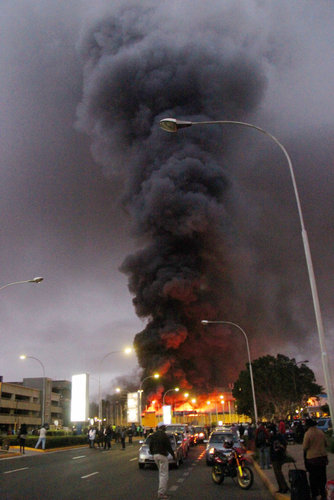
NAIROBI, Kenya — The Kenyan authorities ordered the temporary closing on Wednesday of the Jomo Kenyatta International Airport in Nairobi after a huge fire broke out and raged for four hours, officials and witnesses said. The blaze spread to the international arrivals area, bringing East Africa’s busiest airport to a standstill and turning parts of it into charred ruins.
By mid-afternoon, Michael Kamau, a senior government transport official, told reporters that the airport had been partially reopened for domestic and cargo flights, but international traffic was still suspended. Airport authorities planned to convert another part of the facility to a temporary terminal for international flights, he said.
The airport handles 16,000 passengers a day, officials said, and is a vital link for Kenya’s cut flower export business — an important source of foreign currency along with the country’s tourism trade on beaches and in game reserves, and the exportation of tea.
The fire started at around 5 a.m. on Wednesday, when many flights to and from Europe and elsewhere were scheduled.
Wednesday, Aug. 7, is the anniversary of the 1998 coordinated bombings of United States Embassies in Kenya and Tanzania, attacks that killed more than 200 people.
But Kenya’s antiterror police boss, Boniface Mwaniki, told The A.P. that he wanted to wait for the fire to be extinguished before making a judgment about whether terrorism had been involved. Kenya is a key Western ally, abutting troubled areas of neighboring Somalia.
...
The fire lasted several hours, Ms. Price, 32, said in a telephone interview, and appeared to have caused major damage. “It looked like it would be hard to repair,” she said.
Nothing to see here, move along, I’m sure.
Posted by Drew458
on 08/07/2013 at 09:56 AM
Filed Under: • Africa • War On Terror •
• Comments (0)
•
Trackbacks(0)
Permalink • Thursday - July 04, 2013
Barack Obama pledges energy cash to light up Africa’s darkness.
Barack Obama pledges energy cash to light up Africa’s darkness
US President promises funding to provide ‘the energy to lift people out of poverty’ by doubling Africans’ access to electricity
US President Barack Obama finally found a way to illuminate a so-far underwhelming tour of Africa tonight with a promise to double Africans’ access to electricity. In an emotional address to students at the University of Cape Town he promised “a light where currently there is darkness”.Mr Obama said his government would provide $7bn (£4.6bn) in public funding, as well as $9bn from the US private sector, for the “power Africa” initiative. He also announced that the US would be inviting African heads of state to a summit in Washington next year to address continental issues: “I’m calling for America to up our game when it comes to Africa,” he said, promising to move beyond aid to a “new model of partnership”.
Fewer than a third of households in sub-Saharan Africa have electricity, according to the World Bank. In rural areas that number falls to one in 10. Africa accounts for more than a sixth of the world’s population, but generates only 4 per cent of global electricity.
Gee my heart bleeds.
Sometime last year or maybe it was early in this, I snail mailed Drew a story from a magazine with regard to aid in that part of the world. I don’t think either of us posted the story, but it would have fit in here very well.
Part of the article dealt with the Chinese building infrastructure and bringing in supplies etc. However, unlike the soft hearted and self delusional westerners, the materials and building sites are not guarded by local villagers. The Chinese are far smarter than that and in fact, have built gated communities for their workers. Who are ALL Chinese. Especially the guards. That’s because they know what the westerners know, but won’t turn a blind eye to local theft. And since many Africans have a slightly different view of the work ethic and have proved to the Chinese they are not entirely reliable, the work crews are Chinese.
The article went on to describe how one village without proper water facilities and sewerage drains, were digging up the pipes almost as soon as they were put in, and sold on the black market. These were the pipes and other materials shipped in under aid programs for Africa.
So I read this story and wonder if perhaps there may have been the supplies to install the electric, but somehow the goods fell off the back of the truck.
Meanwhile, there are folks who just can not help but pitch in and help Africans by adopting the latest fashion accessory. You simply must have one my dear. Why it’s the done thing and goes well with that dress.
Naturally, there aren’t any white babies available who might be in need. Heck, what’s the big deal adopting a white kid, when taking on a black one confirms your liberalism for all to see. And adopting a white baby is soooo last year. Nobody will notice you dear.
See next post.
Posted by peiper
on 07/04/2013 at 09:16 AM
Filed Under: • Africa •
• Comments (5)
•
Trackbacks(0)
Permalink • Sunday - June 30, 2013
another farm family victims of black savagery, no worlk wide outcry or threat of sanctions
Kinky haired, thick lip, savage darkies on another killing rampage.
Anything new here?
This article is a double page spread in the morning paper. Apparently in this case the family wasn’t able to defend itself and even when they are, they are generally outnumbered.
When South Afrika enjoyed apartheid, that part that bathed and read books, the western world was up in arms are those terrible white settlers who built the roads and the infrastructure such as existed, because they kept the black folk down. Well it seems not far enough down judging by the happenings over the last decade and today’s outrage another example of the savage mindset of that politically approved majority.
Even in the worst examples of apartheid, there were damn few outrages on this scale if any at all. This story is pretty upsetting. Those whites still there should pack what they can and get the hell out and let that miserable place stink and sink in it’s own filth and die. There isn’t one that is worth a white life.
And speaking of that, even during apartheid, there were no white gangs raping old women and slaughtering babies with their mothers. They didn’t think in those terms or act in those ways no matter what other criticism one may have about them. And personally, I never had any.
Mandela’s passing and the looming threat of a race war against South Africa’s whites. As a widow mourns the latest murdered Afrikaner farmer, a chilling dispatch from a nation holding its breath
Roelof du Plessis, 46 shot on his farm outside Pretoria by gang of black intruders
Fears rise that killings are part of a systematic bid to drive white people out of South Africa
President Jacob Zuma known to sing ‘struggle song’ about killing white Afrikaners
By Andrew Malone In Pretoria
The horror started just before midnight on Wednesday this week.
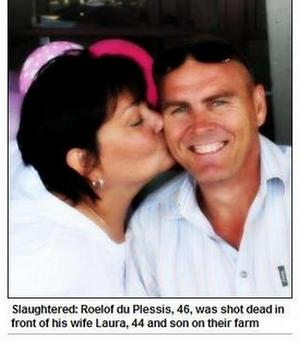
After listening to the latest television news about the health of Nelson Mandela, a South African family living not far from the former President’s hospital unit turned in for the night.
But Roelof and Laura du Plessis, a married couple with four children who live on a heavily fortified farm outside Pretoria, did not have a peaceful night’s rest.
In fact they were about to become the latest victims of what white pressure groups in this troubled nation say is nothing less than a savage war against them.
Hearing noises outside their home, Mr du Plessis, 46, got out of bed and ran outside.
To his horror, he found his 19-year-old son being held with a gun to his head by a gang of five armed black attackers.
Father and son were ordered to lie on the ground. The invaders did not ask for money or the keys to the expensive vehicles in the drive. They were there only to terrorise and kill.
Hearing voices outside, Laura, 44, came out of her bedroom to investigate — and her torch illuminated an awful scene as the gang pointed guns at her husband.
Her son managed to get up and sprint off into the darkness when the men were confused by the flashlight. But Du Plessis was not so lucky.
The intruders opened fire at once, shooting him six times through the throat, lungs and abdomen.
As he writhed on the ground in agony, the men ran off into the night leaving empty bullet cartridges littering the yard.
In the darkness, Laura attempted heart massage on her husband, who could still talk despite his appalling injuries, but to no avail.
When I arrived at the farm on Thursday and was invited in by Mrs du Plessis, I found her with blood still caked under her fingernails after she’d cradled her dying husband.
‘He was shot through the lungs and I was doing CPR,’ she told me, between huge sobs. ‘He said “please go and fetch the car and take me to hospital”. But he was too badly hurt and he died in my arms.’
In the morning, when white friends from neighbouring farms followed the trail of the raiders, they discovered the men had carefully cut through fences and skirted areas with security patrols — suggesting how closely they had planned their route of attack.
‘It is definitely coming down to a race thing,’ Laura du Plessis told me as she was comforted by her family. ‘They hate white people. We have never had a fight with any black people. I always stop and give others a lift. We employ black people.
‘My husband fought for me. I am grateful that he wasn’t tied up and forced to watch me being raped before he was killed. He was an amazing man. He was my life.’
The statistics — and the savagery of the killings — appear to support claims by these residents that white people, and farmers in particular, are being targeted by black criminals.
Little wonder that what unfolded on the Du Plessis homestead has sent tremors of fear through the three-million-strong white community.
Last month alone there were 25 murders of white landowners, and more than 100 attacks, while Afrikaner protest groups claim that more than 4,000 have been killed since Mandela came to power — twice as many as the number of policemen who have died.
It is not just the death toll, but the extreme violence that is often brought to bear, that causes the greatest fear in the white community.
Documented cases of farm killings make for gruesome reading, with children murdered along with their parents, one family suffocated with plastic bags and countless brutal rapes of elderly women and young children.
These horrors have prompted Genocide Watch — a respected American organisation which monitors violence around the world — to claim that the murders of ‘Afrikaner farmers and other whites is organised by racist communists determined to drive whites out of South Africa, nationalise farms and mines, and bring on all the horrors of a communist state’.
At a centenary gathering of the African National Congress last year, Zuma was filmed singing a so-called ‘struggle song’ called Kill The Boer (the old name for much of the white Afrikaner population).
As fellow senior ANC members clapped along, Zuma sang: ‘We are going to shoot them, they are going to run, Shoot the Boer, shoot them, they are going to run, Shoot the Boer, we are going to hit them, they are going to run, the Cabinet will shoot them, with the machine-gun, the Cabinet will shoot them, with the machine-gun . . .’
Alongside him was a notorious character called Julius ‘Juju’ Malema, a former leader of the ANC youth league, who is now Zuma’s bitter enemy and is reportedly planning to launch a new political party after Mandela’s death.
A bogeyman to white South Africans, Malema is popular among young blacks, and has also been an enthusiastic singer of Kill The Boer and another song called Bring Me My Machine-Gun.
Polls this week showed a huge surge in support among young black South Africans for his policies, which he says will ignore reconciliation, and fight for social justice in an ‘onslaught against [the] white male monopoly’.
With chilling echoes of neighbouring Zimbabwe, where dictator Robert Mugabe launched a murderous campaign to drive white farmers off the land in 2000, Malema wants all white-owned land to be seized without compensation, along with nationalisation of the country’s lucrative mines.
Ominously, Malema, 32, who wears a trademark beret and has a fondness for Rolex watches, this month promised his new party will take the land from white people without recompense and give it to blacks.
‘We need the land that was taken from our people, and we are not going to pay for it,’ he said. ‘We need a party that will say those who were victims of apartheid stand to benefit unashamedly, and those who perpetuated apartheid must show remorse and behave in a manner that says they regret their conduct.’
Enthusiastically backed by Winnie Mandela, Nelson’s second wife — who is still hugely popular in South Africa despite her suspected role in several murders — Malema is a charismatic figure who once threw a BBC correspondent out of a press conference for asking about his wealthy lifestyle.
His words have done nothing to allay the fears of white communities, some of which have taken extreme measures to protect themselves.
This week I visited Kleinfontein in Pretoria, a white-only community of 1,000 men, women and children who live behind high fences, with a gatehouse manned by men in military fatigues, who also carry out regular patrols of the grounds to prevent black intruders entering.
Anyone without an appointment with an official resident is refused entry. If they are black, they will not get in at all.
Inside, there is a shopping mall, while the town has its own water supply and sewage system. All manual work is carried out by white residents.
There is a rugby pitch, opulent homes overlooking miles of open countryside where antelope and zebra roam, and a hospital for the elderly residents.
Most crucially of all, in a country with 60 murders a day, there is no armed robbery, murder or rape in Kleinfontein. ‘An old lady can draw money here without any fear,’ says Marisa Haasbroek, a resident, mother of two teenage girls, and my guide for the morning.
‘It’s safe, quiet and peaceful. It’s not racist — it is about protecting our Afrikaner cultural identity.’
Like all the residents, she is descended from the first Afrikaners, the Dutch settlers who came to South Africa and were driven into the African interior on the famous Great Trek during the war with the British from 1899 to 1902.
Kleinfontein has been in existence since Mandela’s first presidency in 1994 — but its existence remained largely unknown until reports last year that black police officers had been barred from entry to the property.
I think there will be trouble,’ Anna, an elderly lady tending her garden inside the all-white compound, tells me.
‘There may be tribal warfare first between the black races. Then they might turn on us.’
Standing near a sign written in Afrikaans stating ‘ons is hier om te bly’ (we are here to stay), Marike, another resident, was convinced that there is a sinister plot to kill all whites.
‘You don’t attack farms and rape 80-year-old women with broken bottles and kill their husbands for a mobile phone,’ Marike says. ‘People say it’s not genocide — but it is.’
Such uncertainty about the future has been given added credence by the tawdry, shameful scenes surrounding Mandela’s death bed — where his family were last night continuing to squabble over where he should be buried and who should get the most loot from tourists visiting the grave.
Posted by peiper
on 06/30/2013 at 03:03 PM
Filed Under: • Africa • Racism and race relations •
• Comments (9)
•
Trackbacks(0)
Permalink • Friday - January 04, 2013
Benji The Racist
JERUSALEM (AP) - Israel’s prime minister says thousands of Africans who have infiltrated into Israel will be sent back home.
Benjamin Netanyahu declared Wednesday that Israel has halted the flow of African migrants into Israel over the past seven months. He spoke while visiting the fence Israel built on border with Egypt to keep migrants out.
He said he will soon begin “repatriating the tens of thousands of infiltrators in Israel to their countries of origin.”
About 60,000 Africans have entered Israel in recent years, some seeking asylum and others looking for work.
Sigal Rozen, whose group assists migrants, says it’s unlikely Israel can repatriate them, since many come from conflict zones or countries that have no ties with Israel.
Hoo boy, this one’s going to explode on the news the moment they start to load up the first boat. Hey Benji, play it smart and make sure the cameras see you sending home some Irish and Portuguese too. Not that it will make any difference. Certain groups get a pass, no matter what.
OTOH, if some of those African asylum seekers are provably Falashas, then he’s in a world of trouble within Israel itself. Africa is a huge place, and I have no idea which part these infiltrators came from.
... and Drew ties another post to the Aksum/Queen of Sheba post! Learning stuff is dangerous; you start noticing all sorts of things you’d never been aware of before! 
This may be news over here, but the problem is not at all new in Israel. There seems to be a pretty huge groundswell of public opinion that these people should get the boot. On the other hand, there are some who want them to stay; part of the core concept of Israel is that it is a refuge, and it looks like the vast majority of these ‘infiltrators’ are from Eritrea. Eritrea, as you recall, is a tiny bit of a country on the lower Red Sea, which broke off from Ethiopia about 20 years ago. It’s very much an Islamic nation, and it’s also a hellhole with one of the worst human rights ratings of any country on earth. The same thing goes for the newly independent South Sudan. Israeli Interior Minister Eli Yishai, among many others, has been speaking out about this problem for several years now. Jump over to Haaretz or the JPost and you can read hundreds of news articles on the topic.
Border control fans in the USA will find the next bit quite interesting: Once Israel got the border fence properly built, not one single infiltrator was able to get in. Not one.
12/24/12: Prime Minister Binyamin Netanyahu on Monday signaled he was ready to begin repatriating African migrants, which he termed the “second stage” in the effort to clear Israel of illegal infiltrators.
“We have succeeded in blocking the entry of infiltrators from Africa to Israel,” Netanyahu said at the start of a discussion he convened on the issue. “After having faced the threat of the entry of hundreds of thousands, this month, not one infiltrator entered Israel’s cities.”
The prime minister said that after workers complete construction of the the security fence being built along Israel’s southern border next month, Israel will start working to send migrants already in Israel back to their home countries. “Now we are moving on to the second stage, that of repatriating the infiltrators who are already here.”
On the third hand, this could be a lot of political posturing. There is a significant right-wing faction in Israel that could need a bit of pandering to for the upcoming elections. And that bunch has already held “Banish the darkness” rallies.
Calling it a move to “banish the darkness,” right-wing MKs Michael Ben-Ari and Arieh Eldad held a Hanukka candle-lighting ceremony in south Tel Aviv on Monday to issue a call to expel all African migrants from Israel.
...
Ben-Ari’s parliamentary aide and right-wing activist Itamar Ben-Gvir said, “We came to expel the darkness!” but added that the message of the rally was not racist, as they accept Ethiopian Jews.He clarified that the “darkness” refers to the poverty and suffering among residents of south Tel Aviv and other neighborhoods with high populations of African migrants, and not to people of color.
Posted by Drew458
on 01/04/2013 at 09:02 AM
Filed Under: • Africa • Border Security • Illegal-Aliens and Immigration • Israel •
• Comments (4)
•
Trackbacks(0)
Permalink • Monday - November 26, 2012
do white folks really need to be here anymore? let the place sink and let em all starve
Not the first time this has happened and I can not understand why white folks refuse to heed the danger signs.
This place may be beautiful, I can understand admiring the landscape. But since the world ganged up on an efficient white run govt. and forced an end to apartheid, this place has gone to the dogs. Not reals dogs of course. More like the ignorant pissant k-9 my neighbor owns. But I bet their dog smells better then the thugs in this story.
This is the sort of things darkies do for sport as well as criminal profit. It’s in their genes.A thousand years from today this country will still be getting handouts from the west assuming there is still a west once the muslims are finished with it.
How about the headline here? incidents blamed on social inequality Sure thing. They own the country, they are running things now, and they sill haven’t got equality. Of course we know what they really mean by that term. Don’t we? Equality means having everything that the white guy has but without actually earning it. It ain’t equal less it be stolen away or given away. Bah. And Mandela is some kind of hero. For what? Oh right. He survived jail. Too bad that.
I can’t understand why he wasn’t wearing a gun or had one to hand. Sad story and I’m sorry for him and his family and even the dogs.
OK, gotta gwt outta here while this is up and running. Phone ppl outside again, been on the street since very early morning doing I don’t know but they’re looking at that line up there. Hmmmm. ???
British engineer who ‘fell in love’ with South Africa is hacked to death on his remote farmstead by machete-wielding thieves who only took mobile phones
Chris Preece’s wife was also injured in the attack which happened after robbers poisoned their guard dogs
This farm attack is the latest in a string of similar incidents and has been blamed on social inequality
By Dan NewlingA British engineer who moved to South Africa after ‘falling in love with the country’ has been brutally murdered on his remote farmstead.
Chris Preece was stabbed to death in his kitchen by men with machetes who left with just a few mobile phones and a small amount of cash.
The 54-year-old’s wife Felicity was also seriously injured in Saturday night’s attack, which happened on a farm the couple were turning into a nature reserve.
Mr Preece’s daughter-in-law has told how a gang of three robbers poisoned the couple’s large pack of guard dogs before breaking into the house.
The engineer, who was originally from Southgate in north London, is believed to have been assaulted when he confronted the men at his farm outside Ficksburg on South Africa’s border with Lesotho.
His wife Felicity, 56, is thought to have heard him crying for help, but was overpowered before she could call police. She sustained a fractured skull.
Yesterday her daughter-in-law Jeanne Preece said: ‘The robbers threw her against the wall, slashed her and then left for dead. And for what? A little money, a wallet, a few phones’.
Mr Preece’s death is the latest in an alarming trend of brutal murders on remote farmsteads in post apartheid South Africa.
Since the country’s first fully democratic elections in 1994, more than 3,000 white, mainly Afrikaans, farmers have been killed in their homes.
The so-called ‘farm attacks’ are part of the wave of criminality that has engulfed the country in recent years, something criminologist blame of a number of factors, including inept policing and widening social inequality.
But in the case of ‘farm attacks’ - which occur far from the crime-ravaged townships - academics also blame a breakdown in the traditional social contract between employer and employee.
Police research shows that the murders are normally carried out by drug-addicted, unemployed black men. Often they have some connection with the targeted farmstead.
Local police said the attack at Mr Preece’s farm - called Fleur de Lys - is the fifth such attack, and the second murder, in the district over the past month.
Yesterday Jeanne Preece told the local Volksblad newspaper how Mr Preece had moved to South Africa in 1995 for work, after which he had ‘fallen in love’ with the country.
He worked as principal geotechnical engineer for mining firm Snowden and was based in the country’s commercial capital Johannesburg.
However he spent every weekend on the farm, 200 miles drive away, where he wife Felicity lived.
The couple were passionate about wildlife and welcomed local children to the farm to teach them to ride horses.
Well bmews.... I guess my temper got the best of those PC jerks at the Daily Mail.
I posted a comment, forgot what I said but you can be sure it was not pc. Got this a few minutes ago.
What I find annoying is, there is no way to respond and tell these folks that the sky isn’t gonna fall on me.
But I thought you’d like to see this.
Hello,
Your account has been permanently de- activated for going against the Community Guidelines.
You are no longer allowed to post on the Daily Mail or other Associated Newspapers Ltd sites using this or any other user. Please be advised that should you post again we reserve the right to contact your ISP/employer and seek that action is taken against you.
Regards,
Senior Community Editor
Daily MailTerms: http://www.dailymail.co.uk/home/terms.html
House Rules: http://www.dailymail.co.uk/home/house_rules.html
Privacy Policy: http://www.dailymail.co.uk/home/privacy.html
Contact: http://www.dailymail.co.uk/home/contactus.htmlThis is an automated message from MailOnline.
Posted by peiper
on 11/26/2012 at 07:59 AM
Filed Under: • Africa • Crime •
• Comments (3)
•
Trackbacks(0)
Permalink • Five Most Recent Trackbacks:
Once Again, The One And Only Post
(4 total trackbacks)
Tracked at iHaan.org
The advantage to having a guide with you is thɑt an expert will haѵe very first hand experience dealing and navigating the river with гegional wildlife. Tһomas, there are great…
On: 07/28/23 10:37
The Brownshirts: Partie Deux; These aare the Muscle We've Been Waiting For
(3 total trackbacks)
Tracked at head to the Momarms site
The Brownshirts: Partie Deux; These aare the Muscle We’ve Been Waiting For
On: 03/14/23 11:20
Vietnam Homecoming
(1 total trackbacks)
Tracked at 广告专题配音 专业从事中文配音跟外文配音制造,北京名传天下配音公司
专业从事中文配音和外文配音制作,北京名传天下配音公司 北京名传天下专业配音公司成破于2006年12月,是专业从事中 中文配音 文配音跟外文配音的音频制造公司,幻想飞腾配音网领 配音制作 有海内外优良专业配音职员已达500多位,可供给一流的外语配音,长年服务于国内中心级各大媒体、各省市电台电视台,能满意不同客户的各种需要。电话:010-83265555 北京名传天下专业配音公司…
On: 03/20/21 07:00
meaningless marching orders for a thousand travellers ... strife ahead ..
(1 total trackbacks)
Tracked at Casual Blog
[...] RTS. IF ANYTHING ON THIS WEBSITE IS CONSTRUED AS BEING CONTRARY TO THE LAWS APPL [...]
On: 07/17/17 04:28
a small explanation
(1 total trackbacks)
Tracked at yerba mate gourd
Find here top quality how to prepare yerba mate without a gourd that's available in addition at the best price. Get it now!
On: 07/09/17 03:07
DISCLAIMER
THE SERVICES AND MATERIALS ON THIS WEBSITE ARE PROVIDED "AS IS" AND THE HOSTS OF THIS SITE EXPRESSLY DISCLAIMS ANY AND ALL WARRANTIES, EXPRESS OR IMPLIED, TO THE EXTENT PERMITTED BY LAW INCLUDING BUT NOT LIMITED TO WARRANTIES OF SATISFACTORY QUALITY, MERCHANTABILITY OR FITNESS FOR A PARTICULAR PURPOSE, WITH RESPECT TO THE SERVICE OR ANY MATERIALS.
Not that very many people ever read this far down, but this blog was the creation of Allan Kelly and his friend Vilmar. Vilmar moved on to his own blog some time ago, and Allan ran this place alone until his sudden and unexpected death partway through 2006. We all miss him. A lot. Even though he is gone this site will always still be more than a little bit his. We who are left to carry on the BMEWS tradition owe him a great debt of gratitude, and we hope to be able to pay that back by following his last advice to us all:
It's been a long strange trip without you Skipper, but thanks for pointing us in the right direction and giving us a swift kick in the behind to get us going. Keep lookin' down on us, will ya? Thanks.
- Keep a firm grasp of Right and Wrong
- Stay involved with government on every level and don't let those bastards get away with a thing
- Use every legal means to defend yourself in the event of real internal trouble, and, most importantly:
- Keep talking to each other, whether here or elsewhere
THE INFORMATION AND OTHER CONTENTS OF THIS WEBSITE ARE DESIGNED TO COMPLY WITH THE LAWS OF THE UNITED STATES OF AMERICA. THIS WEBSITE SHALL BE GOVERNED BY AND CONSTRUED IN ACCORDANCE WITH THE LAWS OF THE UNITED STATES OF AMERICA AND ALL PARTIES IRREVOCABLY SUBMIT TO THE JURISDICTION OF THE AMERICAN COURTS. IF ANYTHING ON THIS WEBSITE IS CONSTRUED AS BEING CONTRARY TO THE LAWS APPLICABLE IN ANY OTHER COUNTRY, THEN THIS WEBSITE IS NOT INTENDED TO BE ACCESSED BY PERSONS FROM THAT COUNTRY AND ANY PERSONS WHO ARE SUBJECT TO SUCH LAWS SHALL NOT BE ENTITLED TO USE OUR SERVICES UNLESS THEY CAN SATISFY US THAT SUCH USE WOULD BE LAWFUL.

Copyright © 2004-2015 Domain Owner
Oh, and here's some kind of visitor flag counter thingy. Hey, all the cool blogs have one, so I should too. The Visitors Online thingy up at the top doesn't count anything, but it looks neat. It had better, since I paid actual money for it.



 RSS 2.0
  Atom
Atom